

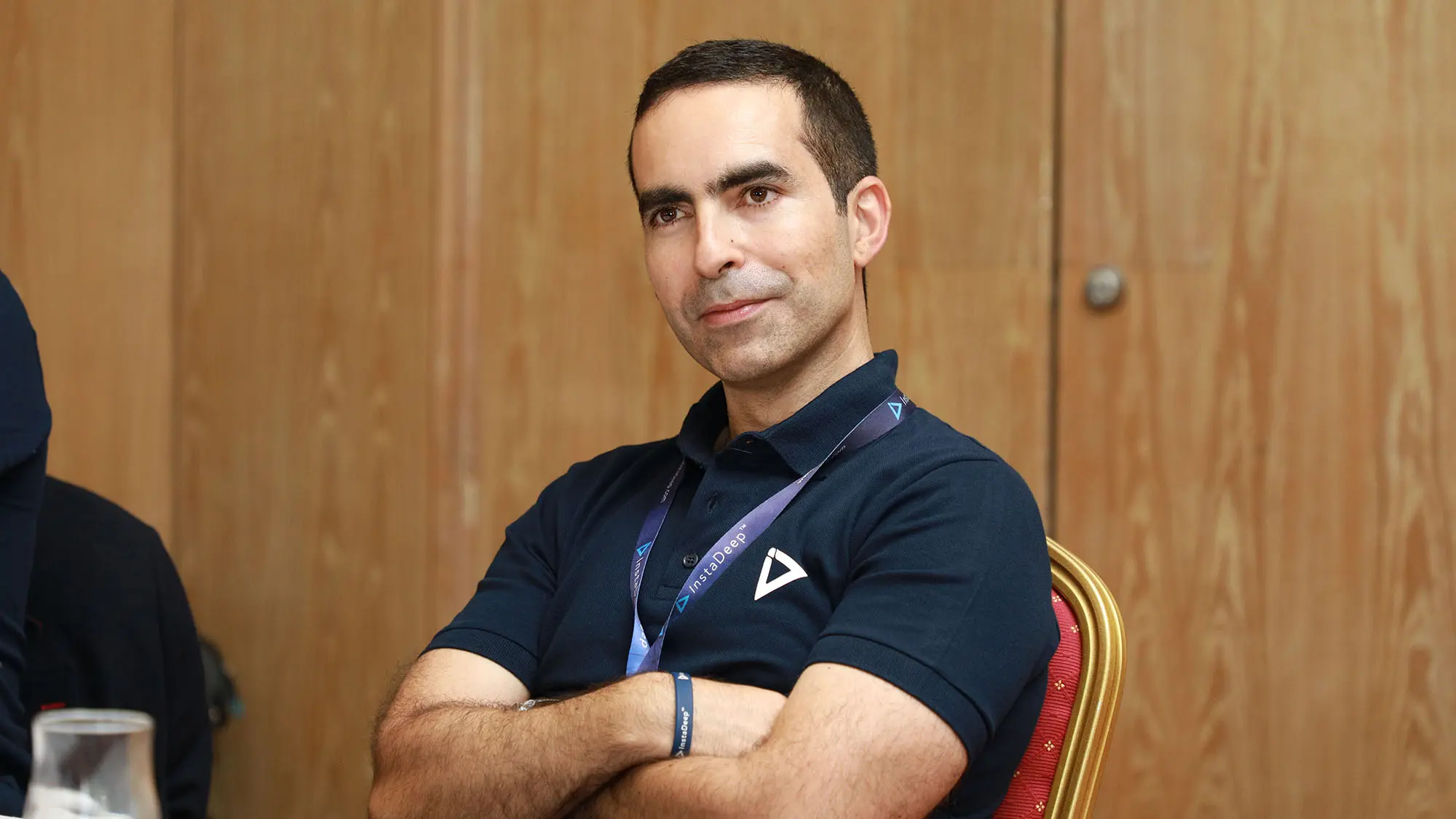
Trajectories — Portrait No. 5
Africa’s largest technology exit is usually reported as $682m. The figure adds a payment that was made to one that may never be, and excludes the stake the buyer already held. What actually happened is more instructive than the headline: a Tunisian mathematician came home from a comfortable European career, spent three years running an agency he did not want to run, pivoted to machine learning in 2017, and sold to BioNTech six years later — from a company headquartered in London.
| Education | Janson-de-Sailly, Paris; École polytechnique; ENSAE ParisTech; Courant Institute, NYU (scholarship) |
| InstaDeep founded | 2014, with Zohra Slim — two laptops, c. $2,000 |
| Pivot to machine learning | 2017 |
| Series A | $7m, May 2019 (AfricInvest, Endeavor Catalyst) |
| Series B | $100m, January 2022 — BioNTech participating |
| Covid variants flagged as high-risk | 0.3% |
| Paid at signing | c. £362m, cash and shares |
| Performance-based milestones | up to £200m |
| Headline total | c. £562m / $682m |
| Deal closed | July 2023 |
| Headcount | c. 300, across nine cities |
| BioNTech UK commitment | £1bn over ten years, 400 jobs |
| Tunisian Startup Act labels | 1,450+ by early 2026 |
Karim Beguir grew up between Tataouine, Djerba, Zarzis and Tunis, took his baccalauréat at Janson-de-Sailly in Paris, went to École polytechnique, then ENSAE, then to New York on a scholarship to study applied mathematics at NYU’s Courant Institute. He started his career in risk control at a financial institution.
That sequence has a destination, and it is London or New York.
The break in this story is not a firing or a collapse. It is a voluntary decision taken from a comfortable position: to go home and build in Tunisia, in a country just out of a revolution, with a fragile economy and effectively no venture capital industry. His own account of it is blunt — nobody believed it could be done there, so he decided to do it himself.
The part the success stories delete
InstaDeep was founded in 2014 with Zohra Slim, a self-taught technologist who had run a digital communications agency. Starting capital: two laptops and about $2,000.
And the company did web design.
For three years it was not an AI company at all. It was a services agency funding its own survival while its founder worked out what the real business was. The pivot to machine learning came in 2017.
That is the most useful fact in this profile and it is almost always cut. The founder spent three years doing something less ambitious than what he wanted, in order to afford doing what he wanted. It is a far more common trajectory than the genius who gets it right first time — and a far more reproducible one.
Building credibility before capital
What separated InstaDeep from any other digital services firm was a deliberate positioning choice: be recognised as a research lab, not a vendor.
Beguir founded the TensorFlow Tunis Meetup and ran workshops. The company published research. It became an official Nvidia supplier in 2021 for its GPU-based AI work. In 2022, with Google and Tunisia’s industry ministry, it staged the largest AI hackathon in the MENA region.
The applications were pointedly unrelated to one another: optimising container loading, automating rail traffic for Deutsche Bahn, early warning for locust swarms across Africa.
That scatter was strategic. It demonstrated that the firm sold a capability — optimising complex decisions through learning — rather than a sector-bound product. It is what made a later pivot into biology credible.
Funding followed credibility rather than preceding it: $7m in May 2019 from AfricInvest and Endeavor Catalyst, then a $100m Series B in January 2022. Among the investors in that round: BioNTech. Everything that follows runs through that detail.
The demonstration
InstaDeep was working with BioNTech on cancer therapeutics when the pandemic reordered priorities. The German company faced a volume problem: thousands of Covid variants were appearing, nearly all inconsequential, a few potentially dangerous, and there was no way to assess them all.
Beguir’s question was easy to state and hard to answer. Could a system be taught what makes a variant dangerous, and therefore rank them in advance?
In 2022 InstaDeep delivered an early warning system that isolated the 0.3% of variants worth attention. By Beguir’s account, it caught every major one.
That result, not any pitch, produced the acquisition. An industrial buyer does not buy a promise. It buys a demonstration performed on its own problem.
What $682m actually means
The 10 January 2023 announcement deserves reading properly, because the press rarely reports it correctly.
BioNTech paid roughly £362m at signing, in cash and stock, for all the shares it did not already own. On top sits up to £200m in milestone payments contingent on performance. The headline — about £562m, or near $682m — therefore adds a certain sum to a hypothetical one.
Three consequences follow, and they matter to anyone benchmarking exits.
The contingent portion is an alignment mechanism, not a guarantee; it pays only if targets are hit. The price covers only the remaining equity, since BioNTech had been a shareholder since the Series B a year earlier, and that slice is not in the number. And a meaningful share of the consideration was paid in BioNTech stock, whose value has moved since.
None of this diminishes the achievement. It means the circulating figure is the theoretical maximum of the transaction, not the sum received by the founders. African ecosystems compare exits constantly and compare them on inconsistent bases. This one is worth getting right.
Three questions the story cannot skip
Is it an African exit? InstaDeep is described everywhere as Tunisian. Its headquarters have been in London for years — a deliberate move, made for international ambition and investor access — and some publications simply treat it as a British company. Both readings hold: the founders are Tunisian, the company began in Tunis, engineering teams remain there, but the legal entity that was sold was domiciled in the UK. This is not a semantic question. It determines where tax is paid, where wealth accumulates, and who ultimately captures the value created.
Where do the post-acquisition jobs go? BioNTech has announced roughly £1bn of UK research investment over ten years and 400 additional skilled roles across the group and InstaDeep. Those posts are British. The counterweight is real — an AI school opened in Tataouine with Gomycode in 2023, the hackathons, a substantial pull effect on the Tunisian ecosystem — but the bulk of post-deal growth lands where the acquirer sits. That is the general rule of acquisitions rather than a Tunisian peculiarity, which is precisely why it should be stated plainly.
How much of this was policy? Tunisia’s Startup Act, adopted in 2018 and the continent’s first comprehensive legal framework for startups, delivered tax relief, currency convertibility, wage support and simplified cross-border operations. Convertibility deserves particular attention here: it is the single sharpest friction facing a young CEMAC company trying to invoice internationally and pay talent. The Act had labelled more than 1,450 companies by early 2026. Without that framework InstaDeep would probably still exist — somewhere else.
Read from Douala or Libreville
The first business is often the wrong business, and that is fine. Three years of web design financed the research that created the value. The common error is waiting for the perfect venture instead of generating revenue while you find it.
Technical credibility precedes capital. Meetups, published papers, hackathons, Nvidia certification — the scientific reputation came before the significant rounds. Where investors are scarce and well informed, proof beats a pitch deck.
An industrial acquisition is won by solving the acquirer’s problem. BioNTech did not buy a promising company. It bought a team that had just solved a critical problem on its own turf, having already taken a stake. The shortest route to an exit often runs through a demanding commercial partnership.
And policy does part of the work. Currency convertibility, legible taxation, simplified cross-border operations — these are public decisions, not entrepreneurial merit. No CEMAC economy currently has an equivalent of the Startup Act. That is the most actionable finding in this profile, and it is not addressed to founders.
Tomorrow: Rebecca Enonchong, Cameroonian software entrepreneur and ecosystem builder.