

Trajectories — Portrait No. 4
Infrastructure is a rent asset. Airports, ports and power grids earn their returns from the absence of a substitute, not from competitive advantage — which is exactly why long-horizon capital wants them, and exactly why a weak regulator turns a partnership into a transfer of pricing power. Adebayo Ogunlesi built the thesis into a business, left one of the highest seats in global banking at fifty-something to do it, and sold the result to BlackRock for $12.5bn. For twenty years, almost none of it was deployed in Africa. That verdict is worth reading closely.
| Education | King’s College Lagos; Oxford (PPE); Harvard, joint JD/MBA |
| First job | Clerk to Justice Thurgood Marshall, US Supreme Court |
| Credit Suisse | 23 years, to executive vice chairman of investment banking |
| GIP founded | May 2006, with five partners |
| Gatwick acquired | £1.5bn from BAA, December 2009 |
| Capex deployed at Gatwick | £1.9bn |
| 50.01% sold to Vinci Airports | £2.9bn, completed 2019 |
| GIP IV fund close | $22bn, December 2019 |
| Sold to BlackRock | $12.5bn, closed 1 October 2024 |
| GIP assets under management | c. $189bn, end-2025 |
| BlackRock AUM | c. $14trn |
| Aligned Data Centers | c. $40bn valuation, 2025 |
| BlackRock South Africa exposure | $28bn, and rising (May 2026) |
Adebayo Ogunlesi inherited intellectual capital, not financial capital. His father, Theophilus Oladipo Ogunlesi, was the first Nigerian appointed professor of medicine in the country.
That distinction matters. Like Masiyiwa, Burns and Tawamba before him in this series, he began without money. Unlike them, he began without the assumption that elite institutions were closed to him.
King’s College Lagos, then Oxford for philosophy, politics and economics, then Harvard for a law degree and an MBA simultaneously. A clerkship with Justice Thurgood Marshall at the US Supreme Court. Corporate law at Cravath, Swaine & Moore in New York.
It is an unbroken run of institutional excellence, and there is no rupture in it anywhere. The rupture comes much later, which is what makes it interesting.
Twenty-three years, then the door
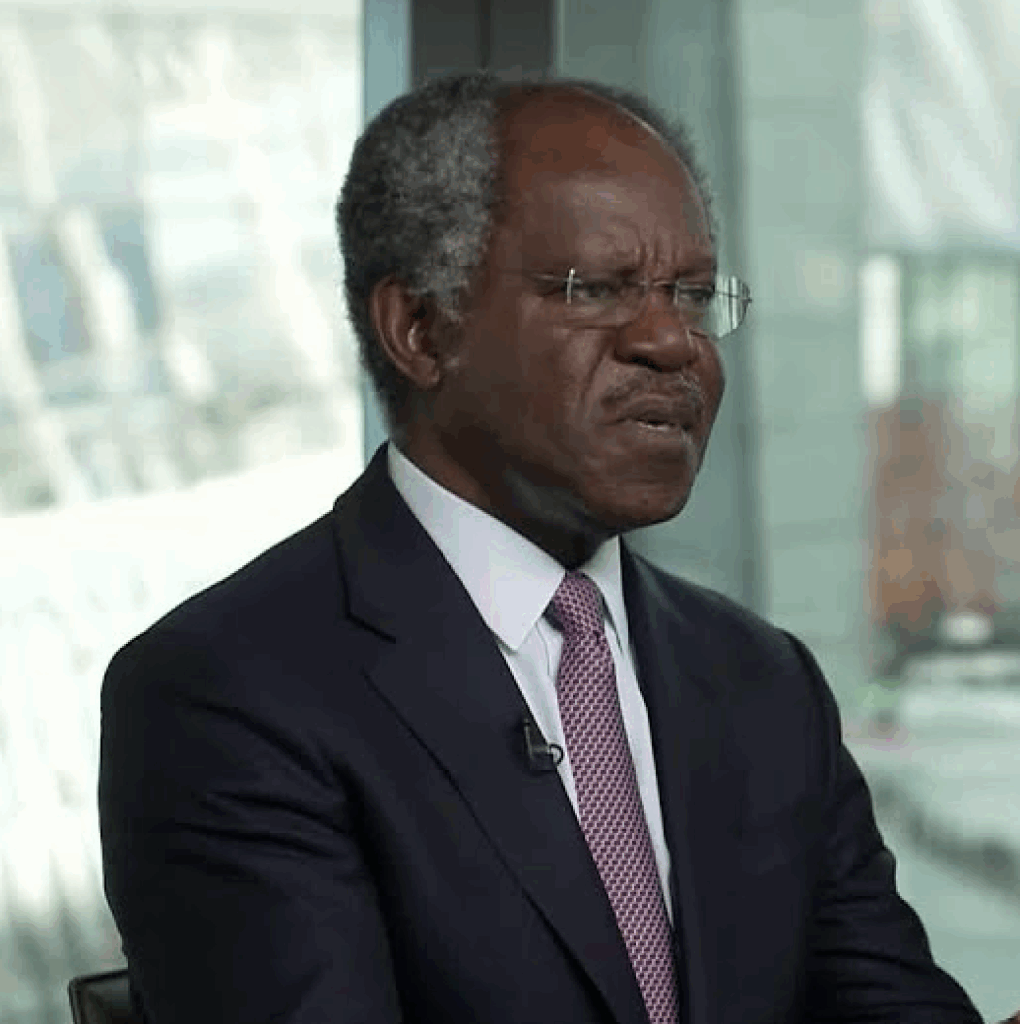
Ogunlesi joined Credit Suisse and stayed twenty-three years — head of the global investment banking division from 2002 to 2004, executive board member, ultimately executive vice chairman and chief client officer.
In May 2006 he left. He was in his fifties, held a position almost nobody reaches, was paid accordingly, and had no rational reason to start again from six people in a room.
The thesis behind Global Infrastructure Partners was unglamorous by design: physical infrastructure throws off predictable cash for decades, is shielded from competition by its own nature, and tends to be badly run — either by public owners or by conglomerates that treat it as a side asset.
It was not a bet on growth. It was a bet on duration, placed eighteen months before structured credit brought the financial system down.
Gatwick
The proof arrived in December 2009. Britain’s competition authority had forced BAA — owner of Heathrow, Gatwick and Stansted — to divest. A GIP-led consortium bought Gatwick for £1.5bn.
What followed is the part worth studying. The consortium put £1.9bn into modernising the airport — more than the purchase price. By the year to March 2018, Gatwick was turning £764m of revenue into £411m of EBITDA: a 54% margin, a figure you rarely see outside rent-bearing assets. That December, GIP agreed to sell 50.01% to Vinci Airports for £2.9bn, completing in 2019, retaining 49.99% and a hand in management.
Read the structure, not just the number. GIP did not exit. It sold half the control to an industrial operator who runs airports for a living, banked a gain, and stayed exposed to the upside. The same template was repeated at Edinburgh Airport in 2024.
A caution, since the error is common in the press: the £2.9bn bought half the equity, not all of it. Set against a £1.5bn purchase price it understates the return considerably.
This is neither property speculation nor industrial management. It is a third discipline — buy the under-managed asset, fund its modernisation, professionalise the operation, then sell part of the control to whoever can run it better than you.
Selling the firm itself
In January 2024 BlackRock agreed to buy GIP for $12.5bn in cash and stock. The deal closed on 1 October 2024. GIP managed over $100bn then; the portfolio now runs beyond $189bn.
Ogunlesi remains chairman and chief executive of GIP, is a senior managing director of BlackRock, sits on its global executive committee and on its board — the board of the largest asset manager in the world, around $14trn. In January 2025 he joined OpenAI’s board. He also sits on the boards of Kosmos Energy, Topgolf Callaway and Terminal Investment.
The logic of selling is a final career arbitrage. An independent fund, however good, must re-convince investors for every new vehicle it raises. Attached to BlackRock, it inherits a global distribution channel and a captive client base. Ogunlesi traded independence for firepower — and did it at the top of the infrastructure cycle rather than after it turned.
The current deployment confirms the discipline. In 2025 GIP moved on Aligned Data Centers, an AI-focused data centre operator, at a valuation near $40bn. The definition of infrastructure has changed. The investment thesis has not moved an inch.
Three questions the story cannot skip
Africa came late. For most of GIP’s history, its founder’s continent was not a material investment destination. The fund bought British airports, Australian ports, European gas networks, American data centres. The turn is recent: in May 2026 Ogunlesi appeared at a Cape Town summit alongside President Ramaphosa and said BlackRock’s $28bn South African exposure was set to grow. He has signalled interest in Nigerian oil assets being shed by international majors.
This is not a moral failing. A fund manager owes a fiduciary duty to his investors, not to his country of birth. But it documents something: for two decades, the most sophisticated infrastructure capital in the world did not find a risk-return profile in sub-Saharan Africa comparable to Gatwick’s. The question is not why Ogunlesi did not invest at home. It is what — in our regulatory frameworks, our courts, our currency regimes — produced that verdict.
Who sets the tariff? An airport, a port, a grid has no substitute. That is what makes it attractive to patient capital and what makes a credible regulator indispensable. Britain’s Civil Aviation Authority caps Gatwick’s charges. In several CEMAC states the equivalent does not exist, or operates with resources incommensurate with the investor it is meant to supervise. A public-private partnership is not a neutral instrument. It transfers pricing power — and without a regulator, it transfers the rent with it.
Structural conflicts. Ogunlesi sits on OpenAI’s board while the fund he runs invests heavily in the data centres that power AI. Nothing improper is alleged, and such overlaps are routine at the top of American finance, with recusal machinery attached. They nonetheless illustrate how few hands now hold allocative power — a fact worth watching from Douala as much as from New York.
Read from Douala or Libreville
Infrastructure is an asset class, not a budget line. A port, a plant, a fibre network can attract thirty-year private capital — provided it is structured as an asset, with ring-fenced accounts, a legible tariff framework and an enforceable contract.
Patient capital exists and is looking for deals. Sovereign funds, pension funds and infrastructure managers hold enormous sums that must be placed over twenty to thirty years. Central Africa’s shortage is not global money. It is bankable files and legal certainty.
It is never too late for the break. Ogunlesi walked away from an exceptional position past fifty to run a six-person firm. That is the exact inverse of the dominant entrepreneurship narrative, which casts the founder as young and with nothing to lose. He had everything to lose.
Sector expertise beats being a generalist. GIP did not win by being one more diversified fund. It won by knowing airports better than anyone. In markets as narrow as ours, specialisation remains the best defence against larger competitors.
Tomorrow: Karim Beguir, whose Tunis-founded AI laboratory was acquired by Germany’s BioNTech.