


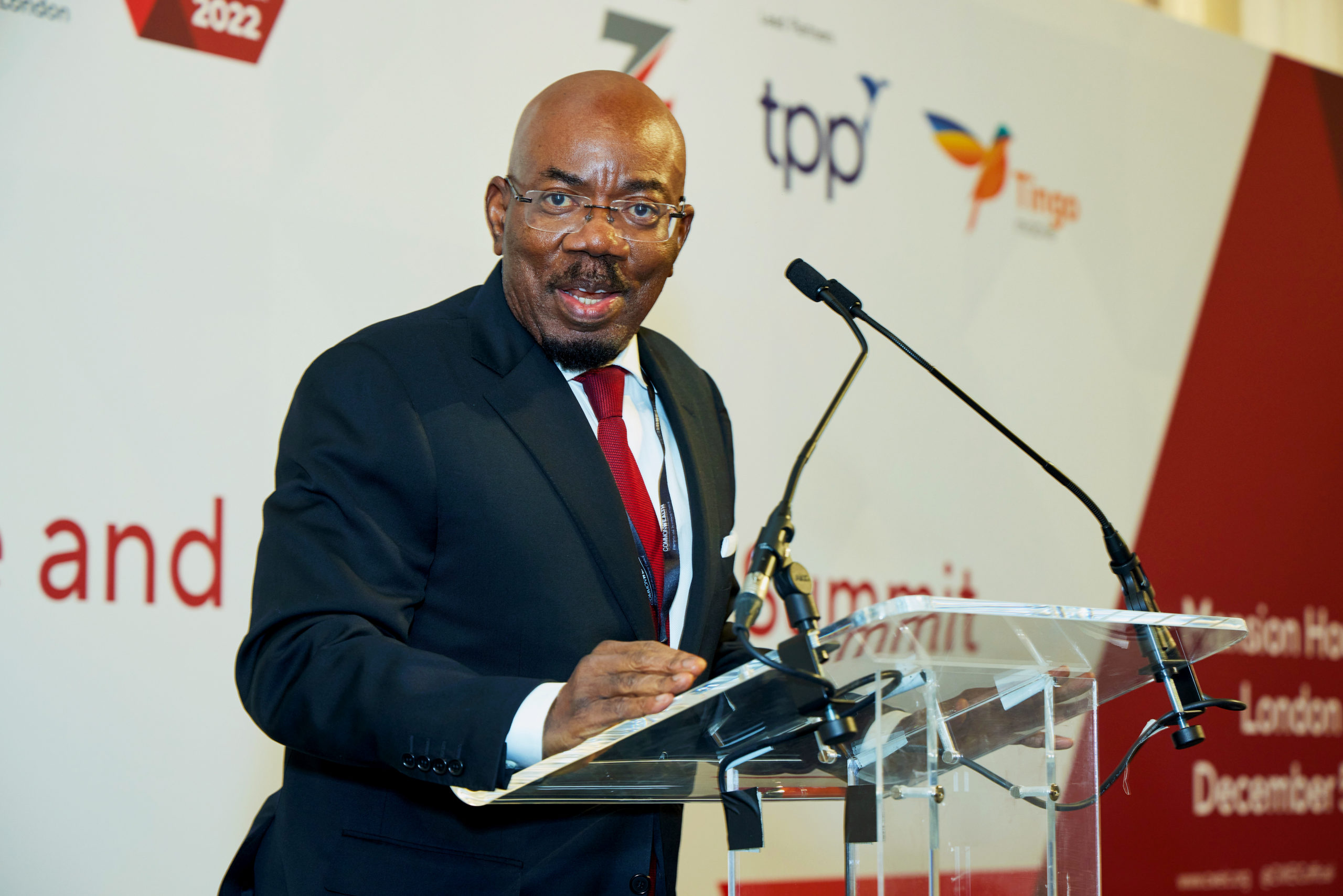
Trajectories — Portrait No. 14, and last
Nigeria’s central bank caps non-executive tenure at twelve years, expressly to stop founders entrenching themselves atop the institutions they built. In 2026 the rule removed both of them: Jim Ovia from Zenith Bank on 5 May, Tony Elumelu from UBA on 21 August. In the months around his exit, Ovia was buying stock. He now holds roughly 16.2% of Zenith, up from the 11–12% disclosed in 2024 filings. A tenure cap moves the chair. It does not move the share register — and this series ends where portrait seven suggested it would.
| Zenith Bank founded | June 1990, ₦20m shareholders’ funds — c. $4m at the time |
| Group managing director | 1990–2010 |
| Became chairman | 16 July 2014 |
| Retired | 5 May 2026, at the CBN’s 12-year limit |
| Successor | Mustafa Bello, engineer, director since December 2017 |
| Ovia’s stake now | c. 16.2%, c. 5.08bn shares |
| Purchase in December 2025 alone | ₦14.8bn |
| Stake value, June 2026 | $643m |
| 2025 interest income | ₦3.6trn (c. $2.3bn), from ₦2.7trn |
| 2025 pre-tax profit | ₦1.26trn (c. $810m), −4.78% |
| 2024 recapitalisation raise / resulting capital | ₦350.46bn / ₦614.65bn |
| Regulatory threshold, international authorisation | ₦500bn |
| NPL ratio, Q1 2026 | 3.79% |
| Foreign subsidiary profit, 2025 | ₦116.43bn, +24.67% |
| Recent expansion | Côte d’Ivoire subsidiary, Paramount Bank (Kenya), Manchester branch |
Jim Ovia founded Zenith Bank in June 1990 with ₦20m of shareholders’ funds — around $4m at the exchange rate of the day.
The figure looks trivial now and was not. Nigeria in 1990 had dozens of banks, many undercapitalised, poorly run, and destined to disappear. Founding one was unremarkable. Founding one that would last thirty-six years was not.
Ovia trained in the United States: a business administration degree at Southern University in Louisiana, an MBA at the University of Louisiana, later Harvard Business School’s owner-president programme. He ran the bank himself for twenty years, from 1990 to 2010, and returned as chairman on 16 July 2014.
In between came the event that redrew the sector.
2004, from the other chair
Readers will remember portrait seven. In 2004 the Central Bank of Nigeria raised minimum bank capital from ₦2bn to ₦25bn. Of eighty-nine banks, roughly twenty survived.
Elumelu played that reform through merger, folding his bank into an older, larger institution and running the result. Ovia played it by clearing the threshold alone and keeping his institution whole.
Both strategies worked. They produced different ownership structures — and that difference explains a good deal of what happens twenty-two years later.
2024–26: the same mechanism, again
The pattern has just repeated, and it is under way in several CEMAC states.
Zenith completed its recapitalisation in September 2024 through a heavily oversubscribed public offer that raised ₦350.46bn and lifted capital to ₦614.65bn — comfortably above the ₦500bn required of banks with international authorisation.
Nigerian analysts draw a conclusion worth sitting with: the winners of the exercise were tier-one banks, whose dominance was reinforced, plus a handful of newer institutions that gained credibility from clearing the bar. A capital requirement does not redistribute the deck. It consolidates whoever could already meet it.
The numbers followed. Interest income reached ₦3.6trn in 2025 against ₦2.7trn the year before. Pre-tax profit came in at ₦1.26trn, down 4.78% — a decline attributable entirely to the sector-wide unwinding of Covid-era forbearance under a CBN directive, not to anything specific to Zenith. First-quarter 2026 gross earnings rose 6.1%, the NPL ratio stood at 3.79%, and group assets passed ₦30trn.
A Nigerian bank arrives in francophone Africa
This is the part that matters most in this region.
Zenith has launched a subsidiary in Côte d’Ivoire — its entry into francophone West Africa. It completed the full acquisition of Paramount Bank in Kenya, adding East Africa. It opened a Manchester branch in March 2026. Profit from foreign subsidiaries rose 24.67% in 2025 to ₦116.43bn.
These are not the moves of a bank consolidating. They are the moves of a bank accelerating.
The signal for CEMAC institutions is plain. Nigeria’s largest banks have emerged from two successive capital reforms with the equity and the profitability to expand beyond their home market. Côte d’Ivoire is a first step. The franc zone is a set.
What the exit demonstrates
Zenith’s board approved Mustafa Bello’s appointment on 27 April — an engineer, a director since December 2017 and the board’s longest-serving member, formerly minister of commerce and industry and executive secretary of Nigeria’s investment promotion commission. Ovia stepped down on 5 May.
The rule that produced that departure exists specifically to stop founders entrenching themselves.
In the months around it, Ovia was buying. His holding moved from the 11–12% range disclosed in 2024 filings to roughly 16.2% — some 5.08bn shares — including a ₦14.8bn purchase in December 2025 alone. By June 2026 the position was worth $643m.
Be precise about what that does and does not mean.
The purchases appear in regulatory filings, which is why they are known. Director dealings are governed by closed-period and disclosure rules. No impropriety is alleged.
What the fact establishes is simpler, and it is this series’ closing finding. A tenure limit acts on office. It does not act on capital, on relationships, or on the influence a founder exerts over an institution he built and now owns a sixth of. We made that observation about UBA’s succession, where Elumelu’s replacement is the former group chief executive of his own holding company. Zenith supplies the quantified version.
That does not make the rule pointless. Separating management from ownership is a real governance gain: a shareholder, even at 16%, does not chair the meeting, arbitrate appointments or sign the minutes. But measure what the rule delivers — a separation of roles — and do not credit it with what it does not: a redistribution of economic power.
A note on dollar figures
One caution before closing, and it applies to every African banking comparison.
Ovia’s stake reached $643m in 2026 through a combination of share appreciation and naira strengthening. Part of that increase is a currency effect, not value creation. Symmetrically, the valuation collapses reported in earlier years owed largely to depreciation.
Converting the results of a bank operating in naira, CFA francs or cedis into dollars produces volatile series, a fraction of which has no economic content. We flag it here because it is a persistent failing in financial coverage of this continent — occasionally including our own.
Read from Douala or Libreville
Capital reform consolidates the strong. This series has now established that across two separate reforms twenty years apart. Bank executives in CEMAC facing minimum capital increases should start from that: the timetable is not something you endure, and the outcome is decided before the deadline.
Pan-African competition is arriving from the west. Zenith in Côte d’Ivoire, Ecobank recomposed around a reference shareholder, UBA in twenty countries. Language and franc-zone membership will not shelter regional banks for long.
Separate office from ownership. For a founder, leaving a post is not leaving a company. For an investor or a regulator, an organisation chart is not enough: the share register is where power is recorded.
Distrust conversions. Growth expressed in dollars in a volatile-currency market blends performance with foreign exchange. That applies to reading competitors and to presenting your own results.
End of series
This closes Trajectories — fourteen days, fourteen careers.
Three findings run through them, and none was planned.
The first is Western withdrawal, which surfaced four times: Castel selling its Cameroonian mills, Maurel & Prom its Nigerian oil stake, Nedbank its Ecobank holding, and a Cameroonian industrialist attacking a French group’s beer market head-on. Those assets are changing hands now, at prices that reflect seller caution rather than buyer competition.
The second is financing. Every successful local acquisition had an African bank behind it: three Cameroonian banks for generic pharmaceuticals, BGFIBank for the Souza brewery, Afreximbank for the Seplat deal. Where that instrument is missing, the assets go elsewhere.
The third is governance. Two founders removed in the same year by the same rule, two successions built for continuity, both men still on the register. Tenure limits do what they can, which is separate the roles. The rest depends on who holds the shares.
Thank you for reading.