


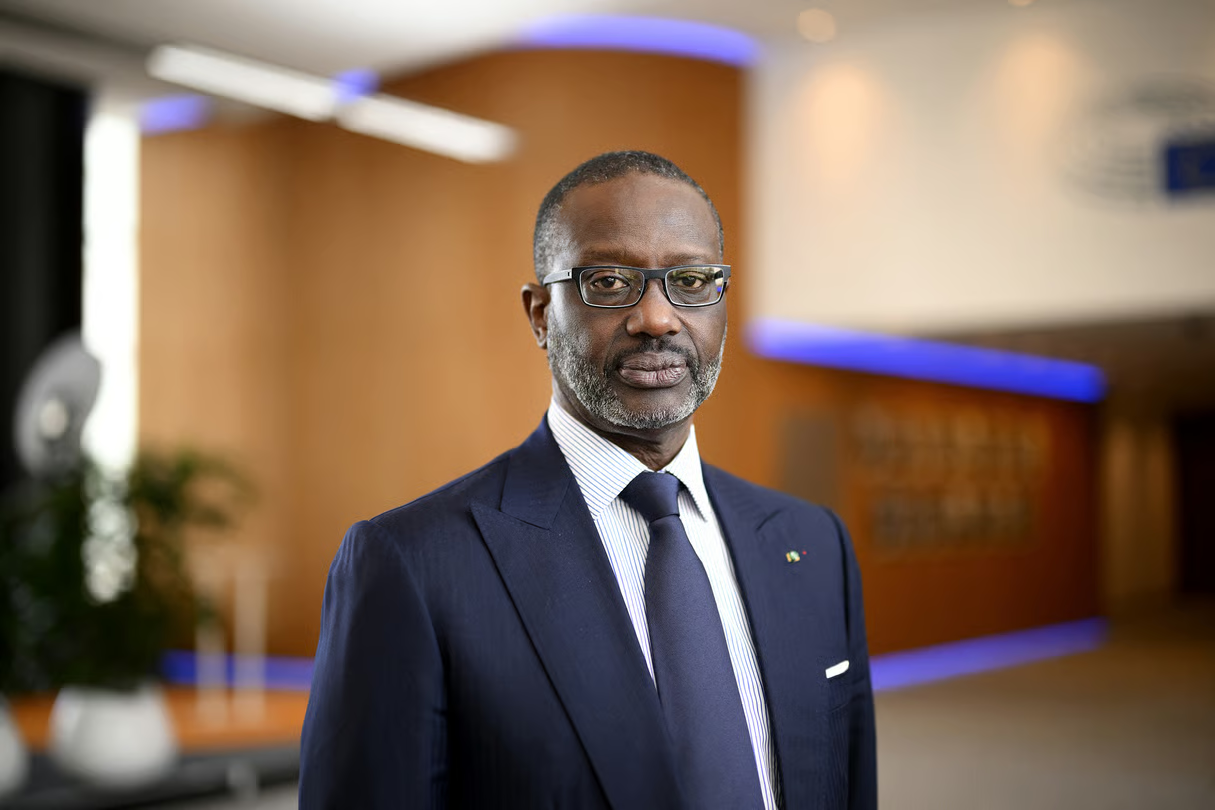
Trajectories — Portrait No. 13
A career built abroad is portable until the day it has to come home. Tidjane Thiam became the first Black chief executive of a FTSE 100 company, then the first African to run a major global bank. In April 2025 an Abidjan court struck him from Côte d’Ivoire’s electoral roll, holding that he had forfeited Ivorian nationality by acquiring French citizenship in 1987 — five days after his party nominated him with 99.5% of the vote, and with no appeal available. He now leads the country’s main opposition party from Paris, by video link. Two readings of that sequence exist. They rest on identical facts, and this is not our election to call.
| Born | 29 July 1962, Abidjan; youngest of seven |
| Lineage | mother Mariétou, niece of Félix Houphouët-Boigny; uncle Habib Thiam, prime minister of Senegal |
| Father | Amadou, Ivorian information minister in 1963; jailed for two years |
| Ivorian minister of planning and development | 1998–99 |
| Left after the coup | December 1999 |
| Prudential CFO / CEO | 2007 / 2009 |
| AIA bid | $35.5bn, backed by a £14.5bn rights issue — the largest ever attempted in the UK |
| FSA penalty, March 2013 | £30m on Prudential entities; public censure of Thiam |
| Credit Suisse CEO | March 2015 – February 2020 |
| Share price over his tenure | −46% (UBS −40% over the same period) |
| Elected PDCI-RDA president | December 2023 |
| French nationality acquired / relinquished | 1987 / decree published 20 March 2025 |
| Struck from the electoral roll | 22 April 2025, no appeal available |
Tidjane Thiam did not start from nothing, and in a series about ruptures that is worth stating plainly.
His mother was a niece of Félix Houphouët-Boigny, Côte d’Ivoire’s first president. His uncle Habib Thiam served as prime minister of Senegal. His father Amadou, a journalist of Senegalese origin, was Ivorian information minister in 1963 — and was imprisoned for two years while his son was small. Growing up inside a political family in 1960s Côte d’Ivoire meant exposure to power’s reversals as much as to its privileges.
He then took the French elite route: École polytechnique, École des mines, an INSEAD MBA, McKinsey.
Masiyiwa, Burns, Altrad and Tawamba built their positions without a pre-existing network. Thiam had a name, an education and relationships. That takes nothing away — running a global bank is not inherited — but it locates the starting line.
Home, then the coup
He returned to Côte d’Ivoire in the late 1990s, headed the state engineering bureau BNETD, and served as minister of planning and development from 1998 to 1999.
The December 1999 coup ended that. He left the country.
The episode explains much of what follows. A public career broken by force rarely produces a serene political return twenty-five years later. It does produce an international one, because human capital travels. He returned to McKinsey in Paris, then joined the British insurer Aviva in 2002.
Prudential: the summit, and the first sanction
He became Prudential’s finance director in 2007 and chief executive in 2009 — the first Black chief executive of a FTSE 100 company.
Five months in, he launched the largest deal in the group’s history: a $35.5bn acquisition of AIA, AIG’s Asian arm, funded by a £14.5bn rights issue, the biggest ever attempted in Britain.
It failed. Institutional shareholders judged the price too high and forced a retreat. AIA later listed in Hong Kong above Prudential’s original offer.
In March 2013 the UK regulator fined two Prudential entities a combined £30m and publicly censured Thiam. The finding was not that the bid was wrong. It was that Prudential had not told the regulator until the news leaked to the press on 27 February 2010 — two weeks after a meeting at which the FSA had asked detailed questions about the group’s Asian strategy and its plans for raising capital.
Two qualifications belong here. The regulator explicitly found the breaches neither deliberate nor reckless. And Thiam was censured, not personally fined.
Even so, the fact matters to a financial reader: a chief executive was held personally responsible for a failure to inform the supervisor. That is a governance finding, not a strategic one.
Credit Suisse: the turnaround, and the exit
Thiam took over Credit Suisse in March 2015 with no direct investment banking experience and from outside Swiss banking — both held against him.
The mandate was restructuring: a pivot to wealth management, capital rebuilt, costs cut, risk reduced. On his departure the chairman credited him with an enormous contribution and a bank returned to profit.
The share price fell 46% over his tenure. The comparison must come with it, because the number is misleading alone: UBS fell about 40% across the same years. It was a punishing decade for European banks, squeezed by collapsing investment banking revenue and sustained low rates.
His exit had nothing to do with performance. Credit Suisse had hired private detectives to follow Iqbal Khan, its former wealth management head who had defected to UBS, and later its former human resources chief. Chief operating officer Pierre-Olivier Bouée — who had followed Thiam from Aviva to Prudential to Zurich — resigned. A contractor involved in hiring the investigators took his own life.
Thiam consistently stated he had no knowledge of the surveillance of his two former colleagues. The board accepted his resignation unanimously in February 2020. Switzerland’s regulator later established that seven observations had been planned between 2016 and 2019, found serious breaches of supervisory law, sanctioned the bank and opened proceedings against several individuals.
Two qualifications, pulling in opposite directions.
For him: the two disasters that finished Credit Suisse — the $10bn Greensill fund collapse and the $5.5bn Archegos loss, the largest in the bank’s 166-year history — both happened after he left. Attributing the bank’s fall to him is simply wrong.
Against him: five years at the top plainly did not shift a risk culture that went on to produce them. He has acknowledged as much, observing that cultural problems are not solved in five years.
The political return, and the two readings
In December 2023, after Henri Konan Bédié’s death, Thiam was elected president of the PDCI-RDA, the oldest party in Côte d’Ivoire and Houphouët-Boigny’s own. The political bureau named him its candidate for the October 2025 presidential election.
One obstacle remained. The constitution requires candidates to hold Ivorian nationality only. On 7 February 2025 Thiam announced he was relinquishing the French citizenship he had held since 1987; the decree was published on 20 March.
On 16–17 April he was nominated with 99.5% of the vote, unopposed. On 22 April the Abidjan court struck him from the electoral roll: according to one of his lawyers, the presiding judge concluded he had lost Ivorian nationality when he acquired French nationality in 1987. No appeal was available.
Procedural episodes followed. A party member challenged his standing to lead the PDCI at all; he renounced the presidency on 12 April citing judicial harassment, then was re-elected on 14 May with over 99% at an extraordinary congress; the complaint was ruled moot on 22 May; he reportedly obtained a certificate of nationality on 21 August and his party filed his candidacy on 24 August. It was rejected.
Two readings compete, on identical facts.
The legal reading. Article 48 of the Ivorian nationality code provides that an adult Ivorian loses that nationality on voluntarily acquiring a foreign one. Thiam acquired French nationality in 1987. The court applied the text. The constitutional rule on sole nationality predates this dispute and applies to everyone.
The political reading. His supporters point to the timing — removal five days after his nomination — the volume of petitions filed against him, the absence of any appeal, and the parallel action to unseat him from his own party. They see an organised elimination.
We will not adjudicate. It is not our role and not our country. What can be said is narrower and more useful: a legal framework that produces, decades later, the retroactive forfeiture of a nationality over an act performed in 1987 creates an insecurity that extends well beyond one man. It concerns every diaspora.
In 2026 Thiam still leads the PDCI-RDA, from Paris. He addressed the European Parliament in Brussels in May. Party members are pressing for the conditions of a return.
Read from Douala or Libreville
Dual nationality is a legal exposure to be handled early. Tens of thousands of diaspora executives hold two passports. Several nationality codes in this region contain provisions comparable to Article 48, largely dormant. Dormant is not repealed. Anyone contemplating public office at home should have their position examined by a lawyer long before they need to.
The regulator relationship is an executive function, not a formality. The 2013 censure concerned disclosure, not strategy. As CEMAC supervisory authorities grow in capability — banking, markets, competition — the quality of that relationship becomes an asset, and its absence a liability.
A tenure is judged over a period longer than the tenure. Credit Suisse’s disasters came after Thiam left, on positions and a culture that existed while he was there. The reverse also holds: turnarounds credited to one executive often pay out under a successor. Both are arguments against verdicts delivered hot.
Economic power does not convert mechanically into political legitimacy. Running a global group means convincing shareholders and boards. Winning political power means convincing voters and outlasting opponents. The skills overlap only partly — and the second exercise does not forgive administrative blind spots.
Tomorrow, the final portrait: Jim Ovia, founder of Zenith Bank.