


Three days shy of his first anniversary in office, President Oligui Nguema closes the refoundation chapter — and warns his cabinet that the era of credit for intentions is over.
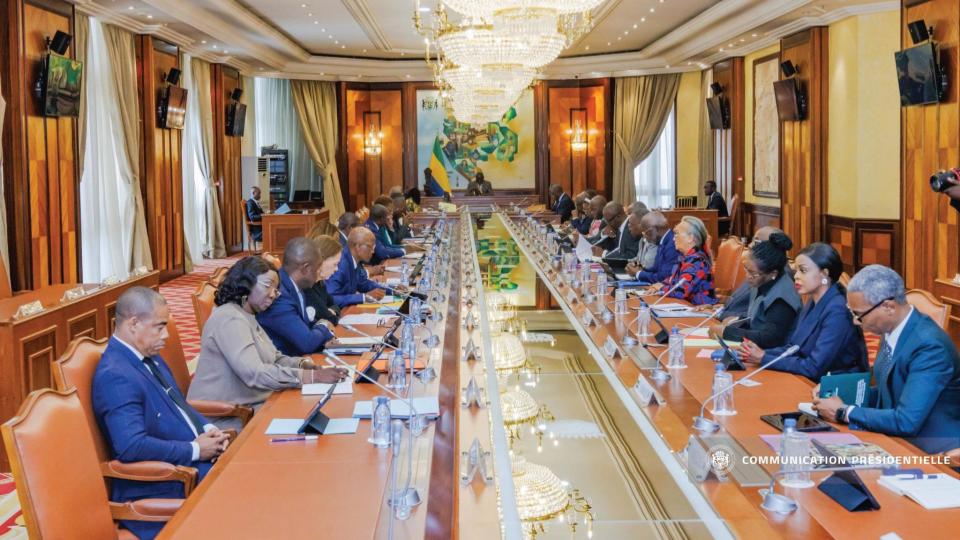
Libreville, May 1, 2026 — On Thursday, April 30, in the deliberation room of the Presidential Palace, Gabon’s Council of Ministers convened under the chairmanship of President Brice Clotaire Oligui Nguema, just 72 hours before the first anniversary of his May 3, 2025 inauguration. What emerged was less a routine cabinet readout than a strategic reset. In a single sitting, the Head of State elevated the Iboga — Gabon’s sacred plant and a coveted pharmaceutical input — to the status of strategic national heritage, sealed a €203 million (≈ CFA 133 billion / US$234 million) package to modernize the Transgabonais railway, banned ministers from sitting at the head of state-owned enterprise boards, and put the entire government on explicit notice: deliver, or face removal.
Reading the official communiqué on Gabon 1ère, Government Spokesperson Charles E. Mombo relayed a sober opening assessment from the President himself. Institutional rebuilding, the restoration of international credibility and the early steps toward economic sovereignty are now established gains. But, the President acknowledged, employment, purchasing power and living standards have yet to register tangible improvement for ordinary Gabonese. The political subtext was unmistakable: Year One was for laying foundations; Year Two will be judged on outputs.
A presidential ultimatum on governance
The Head of State sharpened his demands on the cabinet. The fight against administrative inertia, corruption and embezzlement is to be waged without complacency, with no leniency extended to civil servants — or to ministers themselves. Any minister failing to deliver expected results, or shielding ethical breaches, faces immediate replacement.
The most consequential governance decision flowing from this stance is the outright prohibition on ministers chairing the boards of state-owned enterprises and public agencies. Long flagged by civil society, multilateral lenders and good-governance advocates, the dual-mandate practice had de facto allowed cabinet members to oversee — and audit — entities they themselves directed. The reform aligns Gabon with prudential standards championed by the IMF and the World Bank, and dovetails with the 2024 reorganization of the Gabonese Strategic Investments Fund (FGIS), the country’s sovereign wealth vehicle.
Iboga: from sacred plant to sovereign asset
The headline economic decision concerns Iboga, the alkaloid-rich shrub central to the Bwiti spiritual tradition and increasingly courted by global pharmaceutical firms. Its principal alkaloid, ibogaine, has shown therapeutic promise in treating opioid and stimulant addictions, neurodegenerative disorders, and a range of mental health conditions.
The Council formally classified Iboga as strategic national heritage and adopted a comprehensive regulatory framework governing its access, harvesting, transformation and export. Critically, it endorsed the creation of a dedicated Iboga Sovereign Fund to finance the structuring of the value chain and underwrite domestic scientific research.
The timing is no accident. On April 18, 2026, US President Donald Trump signed an executive order accelerating the development of psychedelic-based therapies for severe mental illness — a move that has reignited fears across the Global South of a renewed scramble for biogenetic resources. By moving first, Libreville signals its intent to capture domestic value rather than supply raw material to a downstream industry that registers patents and books profits offshore. The decision aligns with the Nagoya Protocol, which mandates fair and equitable benefit-sharing from the use of genetic resources, and operationalizes recommendations issued in March 2026 by Gabon’s Economic, Social, Environmental and Cultural Council (CESEC).
For the broader CEMAC zone, the Iboga playbook offers a potential template for sovereign valorization of regional biological assets — from rainforest pharmacopoeia to specialty crops.
Transgabonais: €203M to overhaul the country’s economic spine
The second structural decision endorsed by the Council finalizes the financing architecture for the Modernization and Securing Programme (PMS) of the Transgabonais, the 648-kilometer railway linking the port of Owendo (Greater Libreville) to Franceville. The total envelope of €203 million (≈ CFA 133 billion / US$234 million) breaks down as follows:
- A sovereign loan of €173 million (≈ CFA 113.4 billion) from the Agence Française de Développement (AFD);
- A grant of €30 million (≈ CFA 19.6 billion) from the European Union under its Global Gateway strategy.
The financing convention was initially signed on November 24, 2025, in Libreville, on the sidelines of French President Emmanuel Macron’s official visit. The PMS programme will treat unstable track sections, rehabilitate hydraulic and engineering structures, secure and automate level crossings, and overhaul the Owendo and Franceville stations. Once delivered, line capacity is expected to climb to 16 train paths per day, eight in each direction.
The economic stakes extend well beyond rail engineering. The Transgabonais carries over 300,000 passengers and millions of tons of freight annually, evacuating manganese (Comilog/Eramet) and timber from the interior to the Atlantic seaboard. Gabon’s stated objective is to lift annual freight tonnage to 21 million tons by 2029, against roughly 9 million today. For the CEMAC region — long penalized by logistical bottlenecks that erode export competitiveness — the project is a live test of the bloc’s capacity to mobilize concessional financing at scale and deliver bankable infrastructure.
Cultural identity and economic diplomacy
On the cultural front, the Council mandated the compulsory wearing of African attire every Friday for all public-sector staff. Beyond symbolism, the measure could provide indirect support to Gabon’s textile and craft sectors — segments where the country still imports the lion’s share of finished goods.
Several diplomatic appointments were also confirmed, most notably that of Ms. Alia Maeva Bongo Ondimba (Mrs. Biendi Maganga Moussavou) as Consul General of Gabon to the Republic of Chad. Her husband currently serves as Director General of Orabank Group in N’Djamena — a configuration that quietly extends Gabonese economic presence within the broader CEMAC banking ecosystem.
A still-fragile social and budgetary equation
The President’s own assessment was clear-eyed. Macroeconomic and institutional trajectories have stabilized, with Gabon back at multilateral tables and a renewed dialogue with the International Monetary Fund in motion. But social pressure has not eased. The first months of 2026 brought recurring strikes in education, health and higher education, while persistent Treasury cash-flow strains have slowed the regularization of administrative situations. Youth unemployment, confirmed at 34% by the 2024 ENEC labour survey, remains the most politically exposed flank.
Against that backdrop, the imminent signature of major oil contracts with ExxonMobil and BP — flagged publicly in the days preceding the cabinet meeting — could deliver a much-needed budgetary cushion. Whether those deals translate into measurable second-round effects on jobs, supplier ecosystems and household incomes will be a decisive Year-Two test.
CEMAC takeaway: discipline, sovereignty, leverage
For the Central African Economic and Monetary Community, the April 30 cabinet meeting sends three converging signals: tighter governance of public enterprises, sovereign valorization of strategic resources, and deliberate use of concessional finance aligned with national development priorities. All three resonate directly with longstanding recommendations from the Bank of Central African States (BEAC) and the CEMAC Commission on debt sustainability and productive diversification.
The opening of Year Two leaves Oligui Nguema with an equation that is simple to state but considerably harder to solve: convert restored institutional credibility into measurable purchasing power. The political calendar — postponed professional elections, expiring ministerial roadmaps — will not allow much room for further pacing.