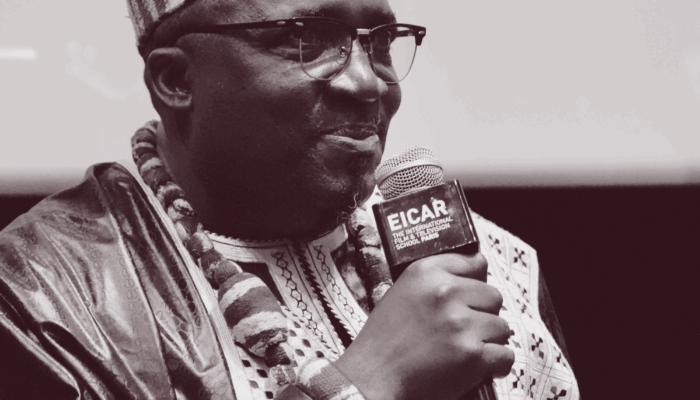


Blaise Pascal Tanguy, founder of L’Afrique Fait Son Cinéma and the driving force behind LE CLUB, champions a vision rare in the cultural sector: turning Afro-Caribbean cinema into a structured economic sector with its own market infrastructure. On 7 May, at EICAR Paris, he launched the first edition of LE CLUB — a coproduction hub reserved for industry decision-makers. A conversation about the inner workings of a ten-year ambition, its business model, and the role this new institution intends to play in a sector undergoing rapid transformation.
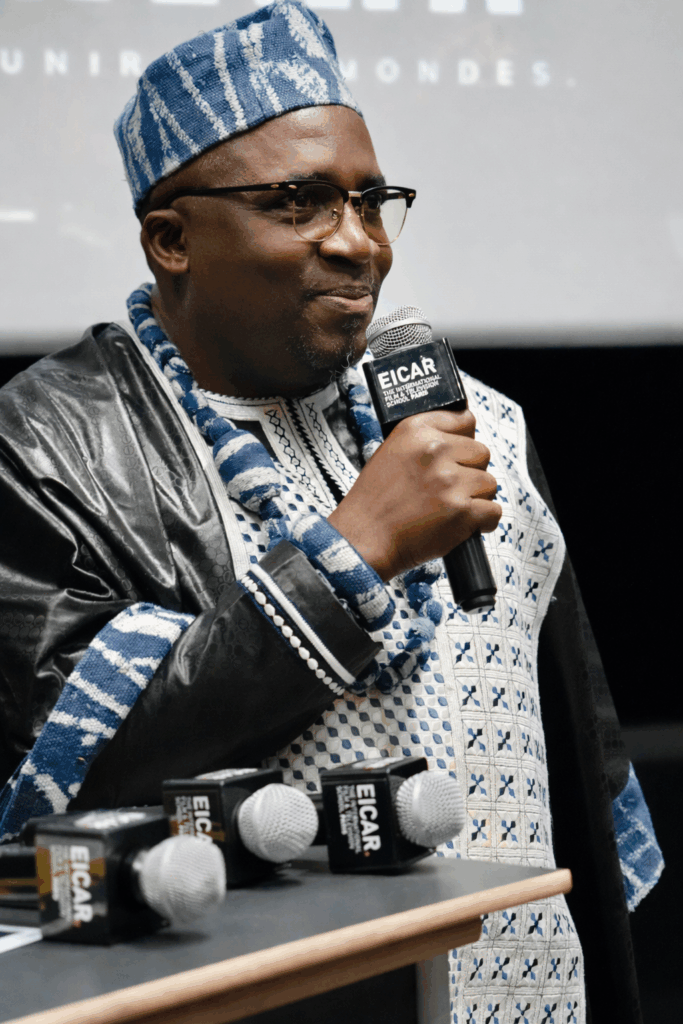
Interview by Kathy Mintsa
Kathy Mintsa · On 7 May, at EICAR Paris, you launched the first edition of LE CLUB. Before we get to the project itself, what was the feedback that struck you most at the end of that first day?
Blaise Pascal Tanguy · What struck me wasn’t any specific piece of feedback — it was a quality of silence. At one point in the afternoon, I looked around the room and saw producers, distributors, lawyers, platform representatives, all engaged in bilateral conversations, focused, pen in hand. Not networking for networking’s sake. Real work. And I said to myself: “We’ve done it.” Because that is precisely what was missing. For the first time, in Afro-Caribbean cinema, we weren’t celebrating or promoting — we were structuring deal flow.
Kathy Mintsa · You speak of “what was missing.” Yet Afro-Caribbean cinema doesn’t lack festivals — FESPACO, JCC Carthage, AFRIFF, Vues d’Afrique — nor does it lack talent. What exactly was missing?
Blaise Pascal Tanguy · The festivals you mention are essential, and we ourselves have been running a festival for seven editions. But a festival, by its very nature, is a programming event: it screens works that have already been produced, sometimes awarded, and it celebrates talent. What was missing — and this isn’t a judgement, it’s a structural observation — is the link between the intention to coproduce and the signed agreement. The marketplace.
Take any major film industry in the world: Hollywood, Cannes, Berlin, Toronto. What makes them powerful isn’t just their festivals: it’s the market infrastructure that surrounds them. Cannes has the Marché du Film. Berlin has the Co-Production Market. Toronto has the Industry Conference. Afro-Caribbean cinema had none of this. The talents were there, the works were there, but the channel that turns all of that into an industry simply didn’t exist. That absence has cost us decades in value terms.
Kathy Mintsa · LE CLUB presents itself as a coproduction hub. In concrete terms, what happens during an edition?
Blaise Pascal Tanguy · A seven-hour day, calibrated down to the minute. Project holders selected in advance — fifteen for the first edition — pitch in front of a curated panel of decision-makers. Not an audience, decision-makers: producers with signing authority, platform buyers, distributors, potential sponsors. Then bilateral meetings unfold in fully-equipped deal rooms. And — this is the cornerstone that sets us apart — specialised audiovisual lawyers are present on-site to formalise agreements as they take shape. You can literally sign a term sheet within the day.
Kathy Mintsa · You emphasise this legal point. Is it really that rare?
Blaise Pascal Tanguy · In professional gatherings within African cinema, yes. Many handshakes, plenty of intentions, very few signatures that actually translate into action. The delay between expressed interest and binding commitment is often what kills projects: schedules fill up, priorities shift, market conditions change. By placing the legal infrastructure inside the room, we shrink that delay to zero. It’s a simple mechanism, but it changes everything.
Kathy Mintsa · Let’s talk about the ecosystem. LE CLUB is being launched by L’Afrique Fait Son Cinéma, which has existed for seven years. What are the different divisions of this ecosystem, and how does LE CLUB fit in?
Blaise Pascal Tanguy · L’Afrique Fait Son Cinéma has been built gradually, around four complementary pillars.
The first, founding pillar is The Festival. Seven editions, more than 4,000 cumulative attendees, 65 films screened in the 2025 edition alone, 500 million cumulative media impressions. It is our cultural and media foundation. It is also our talent pool: this is where we identify works, talents and emerging voices.
The second is The Market, the economic arm attached to the festival. Exhibition space, networking lounges, mentorship programmes. It is the professionalisation layer: this is where projects are prepared and made legible for the market.
The third, and most recent, is LE CLUB, which we’re discussing. The B2B deal-making hub — the layer where everything moves to signature.
The fourth is The Cinebrand Experience, which formalises the relationship between brands and content: product placement, sponsorship, brand integrations. A vastly underexploited territory in Africa, even as major pan-African brands are urgently looking for authentic and differentiated narratives.
And cutting across all of this, there is our editorial division: festival coverage, long-form content, and soon an annual White Paper which aims to become the reference on the state of Afro-Caribbean cinema.
Kathy Mintsa · How do these pillars connect with one another? Is there a typical journey for a project?
Blaise Pascal Tanguy · Yes, and that’s precisely what gives the ecosystem its value. Imagine a young filmmaker who submits a film to the festival. The work is selected, screened, noticed. The following year, they come back with a new project in development. The Market supports them in structuring their dossier, building their team, refining their business plan. The year after, the project is mature enough to enter the LE CLUB selection. There, they pitch in front of decision-makers, sign a coproduction, negotiate a platform pre-sale, perhaps even integrate product placement via Cinebrand. The film is then narrated in our editorial content. And one day, it returns, in competition at the festival.
This circulation — from discovery to financing, through professionalisation and market readiness — is what defines our value proposition. To my knowledge, no other actor offers this continuity in the Afro-Caribbean space.
Kathy Mintsa · Let’s turn to what will particularly interest our readers: the business model. LE CLUB isn’t a philanthropic project, I take it?
Blaise Pascal Tanguy · No, and it’s a point I insist on. Afro-Caribbean culture has suffered a great deal from a philanthropic approach which, in trying to help, has often prevented the emergence of robust economic models. Our conviction is that you don’t grow a sector by subsidising it — you grow it by giving it the tools to generate its own value.
LE CLUB is therefore built as a business, with six complementary revenue pillars: annual memberships across tiers — our recurring revenue backbone; event revenues tied to each edition; success fees on deals signed at the Club; the Cinebrand programme; editorial and training revenues, through LE CLUB Academy which we’ll launch in 2027; and, as a complement only, public grants — CNC, OIF, Creative Europe MEDIA, CANEX/Afreximbank.
Kathy Mintsa · What profitability horizon are you targeting?
Blaise Pascal Tanguy · Break-even in year two, structural profitability in year three. These are conservative assumptions, indexed on a gradual scale-up: two editions in 2027, three in 2028, four per year from 2029 onwards. We are currently looking to close a seed round of 250,000 to 400,000 euros to finance our key hires and the digital platform. By 2028, a Series A becomes conceivable, once our performance indicators — memberships, recurring success fees, deal conversion rates — have proven the robustness of the model.
Kathy Mintsa · You mention four editions per year. All of them in Paris?
Blaise Pascal Tanguy · No, and that’s essential. Our ambition is global. Two editions in Paris, which will remain our Francophone anchor and European showcase. One edition on the African continent — Lagos, Johannesburg, Abidjan or Dakar are under consideration. And one edition in the Caribbean or the Americas. Afro-Caribbean cinema is not just Francophone Africa as seen from Paris: it is a transatlantic space — Anglophone, Lusophone, Creole — which must be able to meet on its own ground.
Kathy Mintsa · One last question. What, in your view, would be the scenario in which LE CLUB fails?
Blaise Pascal Tanguy · If we were to remain a pleasant Parisian event without becoming a global institution. If the editions multiplied without the deals following. If reputation outpaced delivery. That’s why we have defined a very simple KPI by which we’ll be judged: the cumulative value of deals signed at the Club and publicly attributed to it. That figure, and that figure alone, will determine whether LE CLUB becomes a reference — or not.
IN CLOSING
At a moment when the cultural economy is asserting itself everywhere as a strategic lever of narrative sovereignty and value creation, Blaise Pascal Tanguy’s initiative deserves close attention. Beyond the legitimate enthusiasm of a founder, what he carries is a solid economic thesis: bringing into being, in the heart of Paris, the institution that has been missing from a sector in full reconfiguration.
If the promise holds, LE CLUB could well become, in the years ahead, one of the defining markers of Afro-Caribbean cinema’s industrialisation — and, incidentally, a case study for thinking, more broadly, about African cultural economics in the 21st century.
The next edition is scheduled for autumn 2026.