


In seven months, three CEMAC sovereigns raised roughly $2.52 billion on international bond markets at coupons between 8.9% and 9.5%. In the whole of 2025, Central African companies attracted $27 million in venture capital — 0.7% of Africa’s total. That gap, not the absence of capital, is the region’s real financing problem. AFSIC – Investing in Africa, which returns to London on 13–14 October 2026 with what its organisers call the fullest agenda in its thirteen-year history, is one of the few venues where the second number can plausibly be moved. Whether Central Africa turns up in strength is another matter.
The arithmetic of absence
Start with the ratio that should worry every investment promotion agency between Douala and N’Djamena.
The six CEMAC economies — Cameroon, Chad, Congo, Gabon, Equatorial Guinea and the Central African Republic — represent roughly 65.5 million people and a combined GDP in the region of $125 billion, or about 4.4% of Africa’s $2.83 trillion nominal output.
Their share of Africa’s private capital is a fraction of that. According to AVCA’s Venture Capital in Africa Report published in February 2026, Africa closed $3.9 billion in venture deals across equity and debt in 2025. By region, North Africa led with $762 million, followed by Southern Africa ($560m), West Africa ($547m), East Africa ($426m) — and Central Africa with $27 million. A further $1.56 billion went to multi-regional companies. AVCA’s Central Africa grouping is wider than CEMAC and includes the DRC, which makes the figure worse, not better, for the franc zone.
Put differently: the region holds roughly one dollar in twenty-three of African GDP and captures roughly one dollar in one hundred and forty-four of its venture funding.
Foreign direct investment tells a parallel story of concentration. UNCTAD’s World Investment Report 2026 puts FDI inflows to Africa at about $70 billion in 2025, down from an exceptional $94 billion in 2024 but still the third-highest total since 1990. Five countries absorbed more than half of it, Egypt alone taking around $15 billion, and six of the ten largest greenfield announcements were in energy and gas. Capital is not scarce. It is selective, and it is not selecting Central Africa.
Sovereigns can borrow. That is not the same as being financed
The counter-argument is that CEMAC has had a good year on the markets — and on the sovereign side, it has.
- Cameroon, January 2026: $750 million, seven-year maturity to 2033, priced at an initial yield of about 10.1%, brought down to roughly 7.8% in euro terms through a dollar-euro swap that hedges the CFA franc’s euro peg. Proceeds went largely to clearing arrears from prior budget years.
- Republic of Congo, May 2026: $850 million at a 9.5% coupon, used chiefly to refinance the 2032 eurobond.
- Gabon, 30 July 2026: $920 million, upsized from a $750 million target after institutional orders passed $1 billion. Seven years to 2033, 9.375% coupon, three-year amortisation grace period, with AFG Capital as financial adviser and Cygnum Capital and Citigroup Global Markets as arrangers.
Three of six member states, roughly $2.52 billion, all within seven months. That is a genuine reopening of market access for a bloc that had been largely absent from the eurobond segment.
It is also expensive money. Gabon’s outstanding eurobonds were still trading at yields above 11% in June 2026 — territory reserved for issuers the market prices for real default risk. Fitch has Gabon at CCC- in foreign currency after its December 2025 downgrade, with a public debt audit under way and a formal IMF programme request lodged in March 2026 still unconcluded. Cameroon sits at B with a negative outlook, reaffirmed in April 2026, with public debt at 41.2% of GDP in 2025.
And sovereign borrowing is not corporate financing. Governments issuing dollar paper at 9-10% do not put equity into a Douala agri-processor or a Libreville logistics firm. That is the specific gap AFSIC’s private-capital formats exist to address — and it is precisely where the region’s numbers are weakest.
Why the ratings panel is the one to be in the room for
AFSIC 2026’s announced programme covers mining and economic impact, fintech and crypto, sovereign credit ratings and local currency bond markets, insurance, healthcare, microfinance, education, power, infrastructure and sustainable development. For a CEMAC delegate, the third of those is not one panel among ten. It is the one with a live regulatory event attached.
The African Credit Rating Agency (AfCRA), sponsored by the African Union through the African Peer Review Mechanism, is headquartered in Mauritius and reported to be launching in October 2026 — the same month as the conference. Its stated aim is not to hand out friendlier grades but to contest the methodology behind the “African premium”: the spread African sovereigns argue they pay in excess of what comparable fundamentals justify. The ECA and APRM’s 2026 Africa Sovereign Credit Rating Outlook pushed the same line, urging the big three to treat domestic borrowing as a deliberate development strategy rather than a distress signal, and calling for AfCRA’s operationalisation to be accelerated.
Note who is sponsoring a panel at AFSIC this year: CareEdge, the Indian rating group that has built an African arm positioning itself on exactly this ground — global analytical standards applied with local market knowledge. BVI Finance is sponsoring another. A CEMAC finance ministry official with 90 seconds of a rating analyst’s attention has a better use for it than most sessions on the agenda.
The local-currency story CEMAC should be selling harder
The second half of that panel — local currency bond markets — is where the sub-region has its most defensible pitch, if anyone shows up to make it.
The macro backdrop has improved measurably. BEAC held its policy rate (TIAO) at 4.75% at its 2 April 2026 Monetary Policy Committee, projects inflation stabilising around 2.3% — below the 3% community ceiling — and expects reserve cover to rise to about 4.52 months of imports, against 4.22 in 2025, with the regional fiscal deficit narrowing from 4.8% to 2.2% of GDP under the PREF-CEMAC framework whose quarterly monitoring was endorsed at the Brazzaville extraordinary summit of 22 January 2026. On BEAC’s baseline (Brent at $87.2), reserves reach FCFA 7,962 billion by end-2026, a 25% gain, lifted in part by the eurobond issuance.
The weakness is depth, and it is structural. Member states have programmed FCFA 3,906.5 billion (about $7 billion) of issuance on BEAC’s regional securities market in 2026. Commercial banks hold 81.5% of the BEAC outstanding stock. Long-dated paper still clears above 7%. On the equity side, BVMAC’s real free float is 14.7%, daily volumes occasionally fall below FCFA 1.2 million, and Cameroon’s Treasury targeted FCFA 580 billion on the BEAC market in Q2 2026 alone against FCFA 150 billion on the exchange for the entire year. The May 2026 listing of BGFI Holding Corporation on the A-PREMIUM compartment was a real event — and a reminder of how rare such events are.
A captive domestic investor base at 7% is not a bond market. Widening it to non-resident holders of CFA-denominated paper is a sales job, and it is done in rooms like the one in Westminster.
Mining: the pitch that writes itself, and the risk that keeps recurring
If any CEMAC sector can command international attention on merit, it is mining — and BEAC is explicitly banking on it.
Cameroon’s 2026-2030 mining strategy channels FCFA 1,748 billion (about $3.1 billion) into three iron ore projects: Mbalam (FCFA 747bn), Bipindi-Grand Zambi (FCFA 570bn) and Kribi-Lobé (FCFA 431bn). Government projections have mining revenue overtaking oil at around $1.75 billion, while hydrocarbon royalties and corporate taxes fall to roughly FCFA 563 billion in 2026 against a projected 12.2% decline in oil receipts. BEAC identifies these same projects, together with two in Gabon, as the principal drivers of regional growth, underpinning an average expansion of about 3.7% by 2027.
The cross-border Mbalam-Nabeba complex remains the headline asset: roughly 35 million tonnes per year of design capacity, a 510 km rail line to the Cameroonian coast, a 70 km spur from Nabeba in Congo, and a dedicated mineral terminal at Kribi.
It is also the standing illustration of the region’s execution risk. The deposit has been “imminent” for well over a decade, held up by financing and rail access, and Sundance Resources reported new ICC arbitration developments as recently as late July 2026. Investors who have followed the file will not need the geology explained to them. They will need the legal and offtake position explained to them.
The question that will be asked in the first ten minutes
Any CEMAC delegation pitching in London this October should expect one topic to come up before the coffee: foreign exchange rules.
Extractive companies must currently repatriate a minimum of 35% of export proceeds into the zone within 150 days. On 23 April 2026, BEAC Governor Yvon Sana Bangui announced that this floor rises to 50% on 1 January 2027 and 70% on 1 January 2028. Separately, site restoration (RES) funds — estimated at around FCFA 6 trillion, close to the entire stock of regional reserves, which stood at FCFA 6,769 billion at end-February 2026 — remain subject to a contested escrow regime and largely outside mandatory repatriation.
The central bank’s logic is defensible: reserve cover at 4.52 months sits below the five months the IMF treats as comfortable, and below three months is where CFA pegs start generating devaluation speculation. The investor read is the opposite one. The African Energy Chamber, a lobby with an obvious position, has argued the framework could cost the region $45 billion in foreign investment by 2050 and $86 billion in government revenue — figures to treat as advocacy rather than analysis, but which circulate widely in exactly the rooms AFSIC fills. The IMF, less polemically, has pressed BEAC to speed up FX request processing and apply the rules predictably.
This is the tension no country summit slide deck resolves. The region is simultaneously travelling abroad to ask for capital and tightening the terms on which capital moves in and out.
What AFSIC actually sells
Clarity on the product matters. AFSIC does not sell content; it sells access.
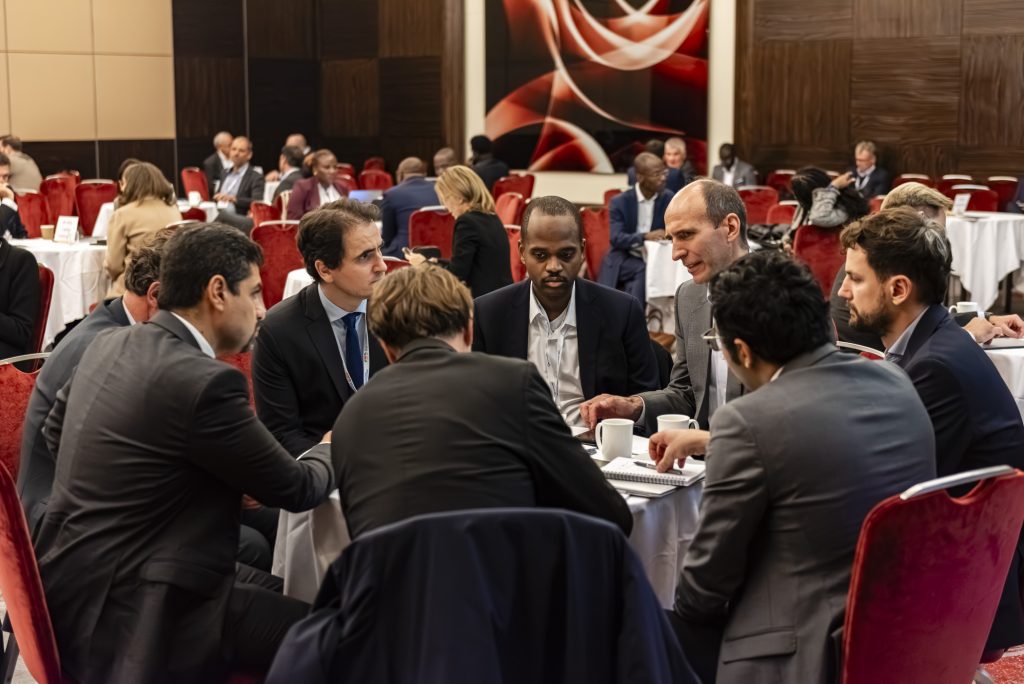
The architecture is the Meet the Investor sessions, Fund Spotlight for managers in the market, the Deal Book of listed projects, a dedicated Deal Room for bilateral meetings, and on-site pitching including short-form formats. The Meet African Dealmakers (MAD) evening — separately ticketed, held at the London Transport Museum — is sponsored this year by British International Investment, the UK’s development finance institution, whose francophone Central Africa exposure has historically lagged well behind its East and Southern Africa book. Organisers also point to more than twenty sponsored country investment summits.
One detail in the announced sponsor roster is worth noting for what it omits. Casablanca Finance City, Brand SA, Saïd Business School, Manufacturing Africa, DTOS, Africa Eats, BVI Finance, UKGCC, Icecap, Meritas, Verdant Capital, Numeral, Strafin, Africa Legal Risk, Aqua Spark, First Mutual, Niofar Consulting, Pro Serve, Aabey House and Tola span Morocco, South Africa, Ghana, Mauritius, the BVI, the UK, Zimbabwe and Senegal. No identifiable CEMAC-based institution appears on the list.
The cost-benefit, plainly
The trip is worth making for three profiles: fund managers actively raising (Fund Spotlight exists for them); microfinance and SME-credit institutions, given the presence of specialist private-credit and financial-inclusion investors such as Verdant Capital; and mining, power and infrastructure sponsors whose projects are advanced enough to survive due diligence rather than merely describe an opportunity.
For everyone else, the honest expected value is a stack of business cards. The event runs entirely in English, attendance is paid, and the all-in cost for a Douala or Brazzaville SME — registration, UK visa, flights, London hotel rates in October — is a real capital allocation decision against an uncertain conversion rate.
But the counterfactual deserves equal scrutiny. BEAC projects regional growth slowing to 2.9% in 2026 from 3.5% in 2025. At that pace, with oil receipts declining, bank balance sheets already 81.5% loaded with sovereign paper, and international borrowing costing between 9% and 10%, CEMAC cannot finance its structural transformation domestically. The capital has to be met where it is allocated. Two days in Westminster is a cheap place to start.
The numbers that frame the trip
| Indicator | Value | Source / date |
|---|---|---|
| CEMAC population / combined GDP | ~65.5m / ~$125bn | ~4.4% of African GDP |
| Central Africa VC funding, 2025 | $27m of $3.9bn Africa-wide | AVCA, Feb 2026 |
| FDI to Africa, 2025 | ~$70bn (vs $94bn in 2024) | UNCTAD WIR 2026 |
| CEMAC eurobonds, Jan–Jul 2026 | ~$2.52bn across 3 sovereigns | Coupons 8.875%–9.5% |
| Gabon secondary yields | >11% | June 2026 market data |
| Regional securities issuance programme, 2026 | FCFA 3,906.5bn (~$7bn) | BEAC |
| Banks’ share of BEAC outstanding stock | 81.5% | Q1 2026 |
| BVMAC real free float | 14.7% | Q1 2026 |
| BEAC policy rate (TIAO) | 4.75% | MPC, 2 April 2026 |
| CEMAC growth forecast 2026 | 2.9% (vs 3.5% in 2025) | BEAC |
| Reserve cover | 4.52 months of imports | BEAC, 2026 projection |
| FX repatriation floor, extractives | 35% → 50% (2027) → 70% (2028) | BEAC, 23 April 2026 |
| Cameroon iron ore capex, 2026-2030 | FCFA 1,748bn (~$3.1bn) | 2026-2030 mining strategy |
Event essentials
AFSIC – Investing in Africa, 13th edition · 13–14 October 2026 · Park Plaza Westminster Bridge, London · Organiser: African Investments Limited · Formats: Meet the Investor, Fund Spotlight, Deal Book, Deal Room, on-site pitching, 20+ country summits, MAD networking evening (separate ticket) · Registration: www.afsic.net (tiered pricing, early registration advised) · Press contact: Olivia Attenborough, Head of Digital Strategy — olivia@africaninvestments.co