

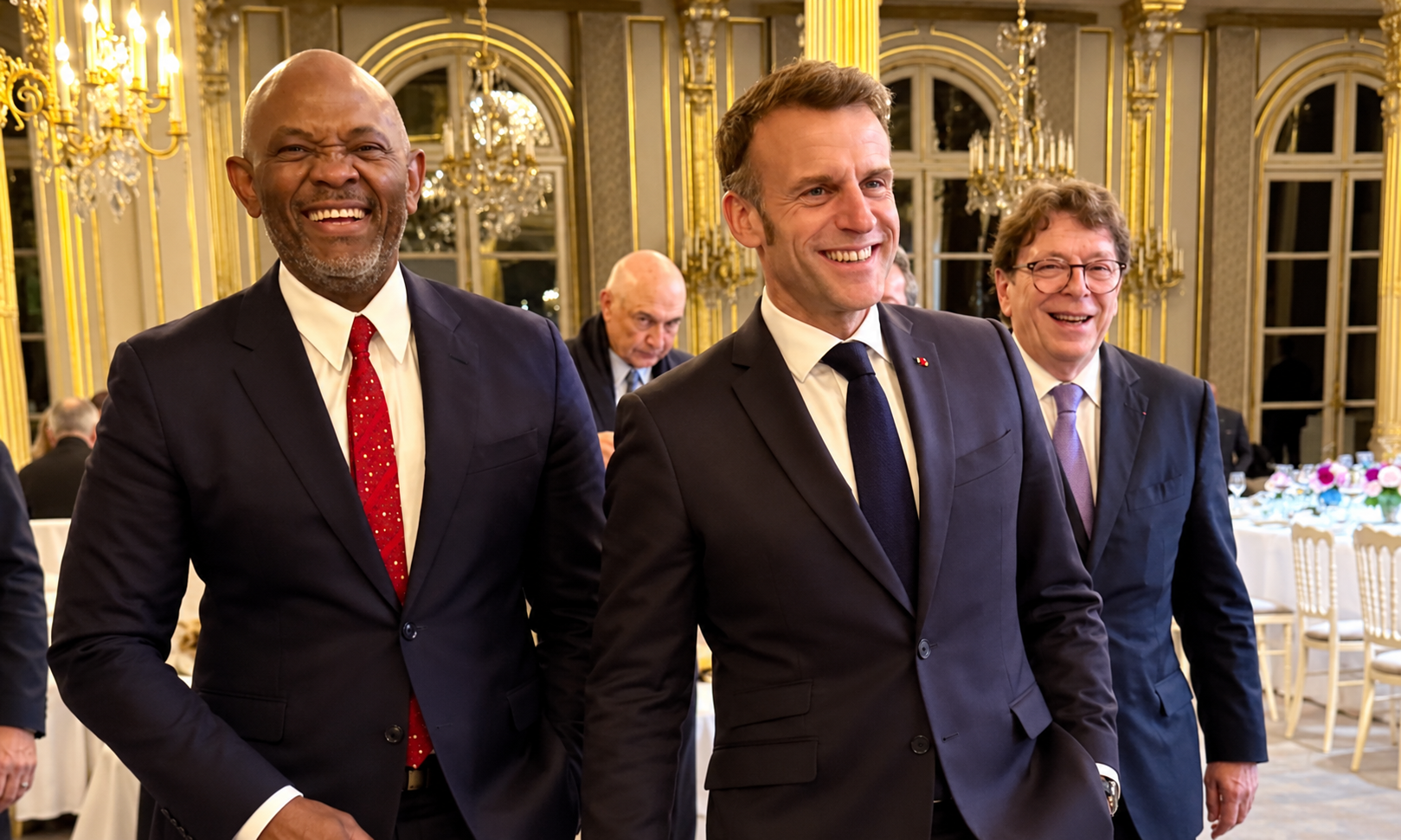
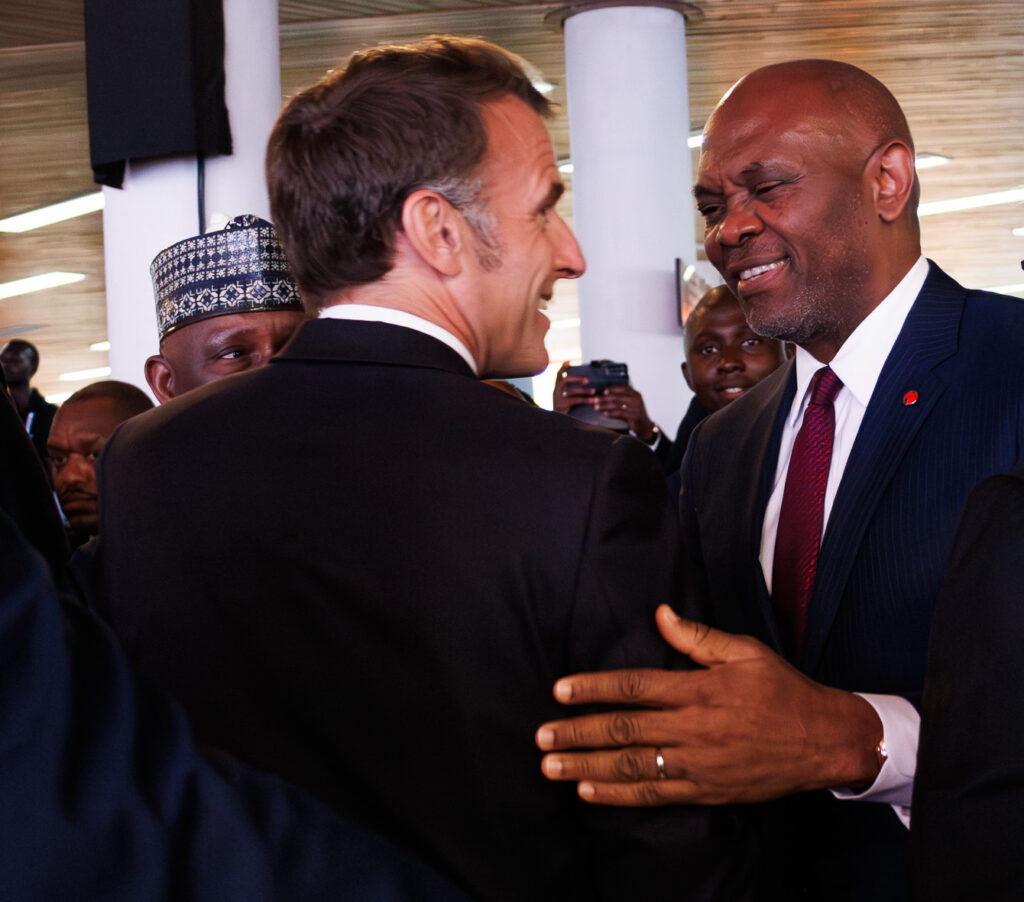
On Sunday 4 October, Emmanuel Macron hosted the business leaders of the Africa-France Impact Coalition at the Élysée Palace, with Benin’s President Romuald Wadagni as guest of honour. Five months after the Nairobi summit, the coalition is becoming a permanent fixture. That leaves three questions about the €23 billion announced in May: what it covers, where it goes, and who holds the pen.
A dinner to anchor the coalition
It was a working dinner. Around Emmanuel Macron sat African and French business leaders and one guest of honour, Romuald Wadagni, who spoke immediately after his host. Sworn in on 24 May, Benin’s former finance minister was on his first working visit to France.
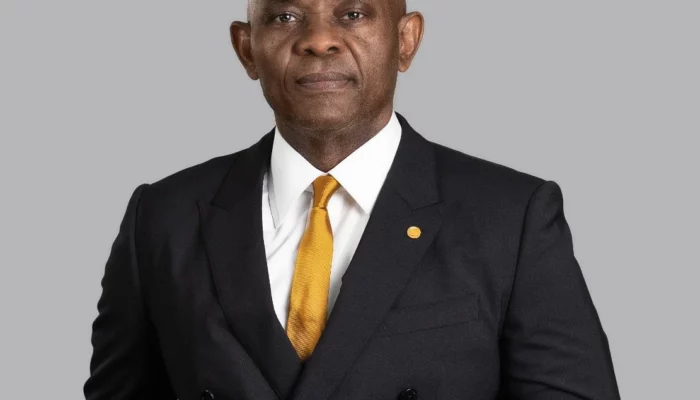
The guests who have been identified include Baïdy Agne, president of Business Africa and of Senegal’s employers’ federation, and Nigeria’s Tony Elumelu, chairman of Heirs Holdings and the coalition’s lead figure. The talks covered follow-up on the projects selected in Nairobi, the opening of Benin’s market to private investors and the industrialisation of the continent.
No new figure came out of the evening. The only number from the Paris sequence is bilateral: the next day, Benin signed agreements worth CFA francs 65.5 billion, close to €100 million, with the French Development Agency (AFD) and Bpifrance. Most of it will go to extending the electricity grid.
The point of the evening therefore lies in its principle. Born as a summit device, the coalition now meets at the Élysée outside any summit, with an African head of state at its table. It is a follow-up meeting, and it invites a recount.
Twenty-three billion: a user’s guide
The figure was announced on 11 May in Nairobi, at the close of the business forum of the Africa Forward summit. It adds €14 billion in French commitments to €9 billion from African investors. According to the Élysée, it covers every instrument, from loans to grants to equity stakes, and mixes companies, funds, foundations and public operators such as AFD, Proparco and the French Treasury. Paris attaches 250,000 direct jobs to it, in Africa and in France.
Only the French share has been broken down. Three sectors account for more than 80% of it: the energy transition (€4.3 billion), digital and artificial intelligence (€3.76 billion) and the blue economy (€3.3 billion). Then come agriculture (€1 billion), health (€942 million), industrialisation (€300 million) and banking (€250 million).
One detail stands out. Industrialisation, the watchword of Sunday’s dinner and of the coalition’s manifesto, weighs €300 million in the Élysée’s classification. That is barely 2% of the French share.
An op-ed published in June by Agence Ecofin argues that these amounts correspond to projects already financed and under way, and are no mere promises. The argument cuts both ways. If the projects had already been launched, the summit catalogued them more than it triggered them. The total then measures Paris’s ability to convene, rather than any additional investment.
Where the thirty projects go
The coalition has published thirty project sheets. Thirteen fall under industrialisation and value chains, thirteen under infrastructure and four under human and creative capital. Fifteen are led by African groups, fifteen by French ones.
Eight of them carry a stated amount of one billion or more.
| Sponsor | Project | Where | Stated amount |
|---|---|---|---|
| TotalEnergies | New investments by 2030, including €2bn in renewables | Continent-wide | Over €10bn |
| Ecobank | Intra-African trade finance over three years | Pan-African | $3bn |
| Canal+ | Content production, 40,000 hours in more than 20 languages | Pan-African | Nearly €3bn |
| Brandon & McCain | 630 km pipeline network, 2026-2030 | Côte d’Ivoire | €1.5bn |
| Carrinho | Soybean, sugar, poultry and grain storage | Angola, Lobito Corridor | Over $1bn |
| MeTL | Graphite, agriculture and fintech | Tanzania, East Africa | $1bn |
| Castel | Five greenfield sites, a distillery, an academy | Several countries | Nearly €1bn in 2026 |
| Eramet | Rail and manganese | Gabon | €1bn |