

How Imane Ayissi — dancer, model, self-taught couturier — became the first sub-Saharan African on the calendar of Paris haute couture, and why he is still the only one

I. The dance at the end
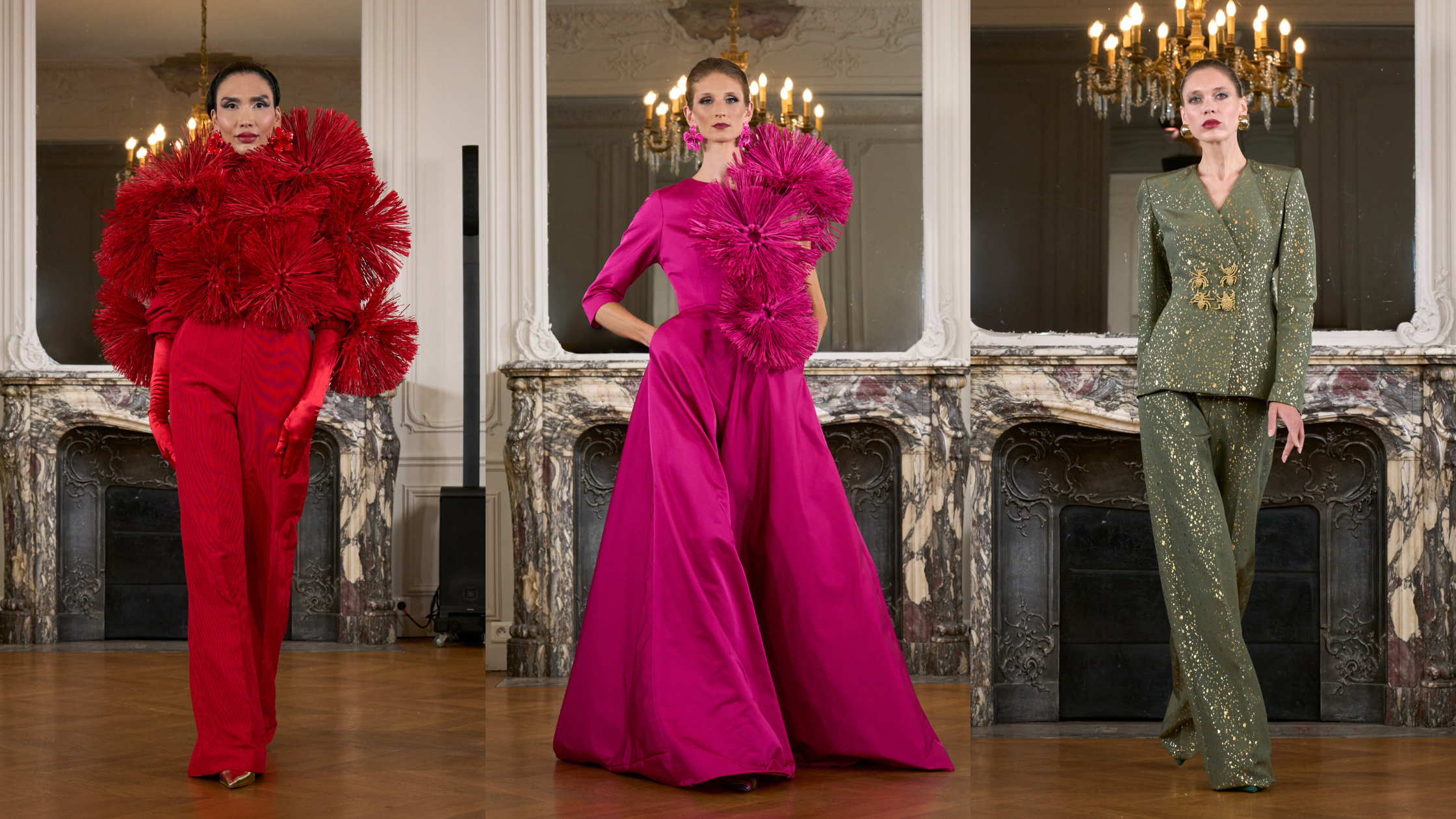
In July 2026, in the gilded salons of the Aéro-Club de France in Paris, a recorded voice asked the guests to fasten their seatbelts. The models came out dressed like flight attendants from a lost era of air travel: gloves to the elbow, saturated silks, raffia fringing spread like wings, headpieces. The collection was called Ozouandam Ollat — Ewondo for “haute couture.”
The show ended with something not on the run-of-show: the designer dancing on his own runway, unplanned, in front of the room.
Six weeks earlier, Julienne Eyenga Ayissi had died. She was the first Miss Cameroon crowned after independence, one of the first Cameroonian flight attendants, an Air Afrique stewardess — and the woman whose dresses her son had been altering, badly and then well, since he was a boy. The collection was her funeral and her portrait. Her son closed it by dancing, because dancing is what he did first, before any of this.
That is the whole arc of Imane Ayissi in one room: a body that learned to move before it learned to cut; an African vocabulary imposed, politely and without apology, on the most codified institution in Western fashion; and a man who arrived where he arrived roughly three decades later than he should have.
II. Yaoundé: a house of bodies
He was born in Yaoundé in June 1968 — some sources say 1969 — into a family whose currency was physical.
His father, Jean-Baptiste Ayissi Ntsama, was a champion boxer. His mother was a beauty queen and a stewardess. His brothers and sisters danced and sang. There was no fashion school in this story, no atelier apprenticeship, no design degree. There was a mother who dressed well and a child who could not leave her wardrobe alone.
This is the origin most profiles reduce to a charming anecdote. It is worth taking literally. Ayissi’s entire method — building a garment on a living body, letting fabric find its shape in movement, treating adornment as something you pull out of the cloth rather than glue onto it — descends directly from a boy reworking a woman’s clothes while she stood in them.
By his teens he was in the Ballet National du Cameroun. He danced behind the great voices of the era — Anne-Marie Nzié, André-Marie Tala, Nayanka Bell, Messi Martin — and later in the Senegalese and Guinean national companies. In 1986 he performed at the Yaoundé Conference Centre before seven heads of state. In parallel, still in his twenties, he was already designing for the largest ready-to-wear workshop in the country.
He was a professional in two trades before he ever saw Paris.
III. Ten years wearing other people’s clothes
He arrived in France in 1992.
Dance carried him first: tours with the étoile Patrick Dupond, stages with Yannick Noah, houses in Nancy and Saint-Étienne. In 1995 he reached the final of the Mannequin Europe competition in Paris, and the runway took over.
What followed reads like a list of the houses that would later decide whether to let him in: Dior, Yves Saint Laurent, Givenchy, Lanvin, Valentino, Pierre Cardin, Francesco Smalto, Claude Montana. Alongside the couture, the working model’s diet — Lacoste, Levi’s, Oakley, Gap, Motorola, Sony Ericsson, the L’Oréal hair shows at the Carrousel du Louvre.
Fashion writing tends to treat this decade as biography. It is better understood as training.
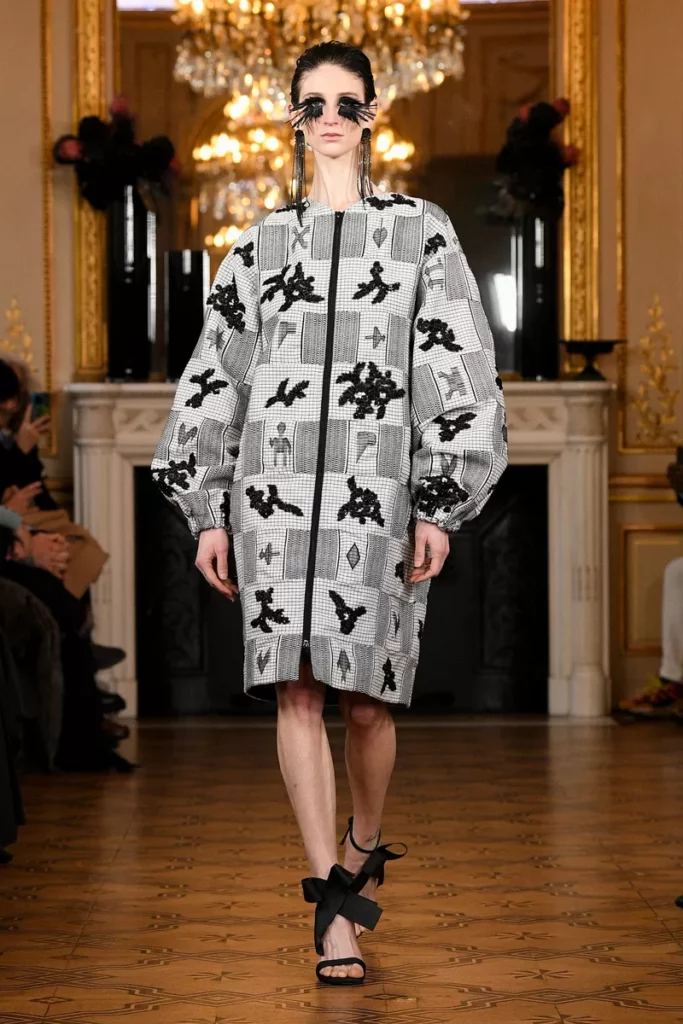
For ten years, Ayissi’s job was to be inside couture — to feel where a sleeve stops an arm, how a train negotiates a corner, what a heavy silk does to a stride, how a garment behaves in the eight seconds it is actually seen. When you look at his collections now — capes that open as the body turns, raffia that sounds, bias cuts that follow the hip, hems that come alive on the step — you are looking at clothes designed from the inside out by someone who was once, professionally, motion.
Very few couturiers have ever had that education. Almost none of them had it and then had to wait thirty years to use it.
IV. Twenty-eight years at the door
He staged his first Paris show in 1993, one year after arriving, out of a small room with a sewing machine.
Then came the long middle. Galas. Charity shows. Hairdressing spectaculars. A Sciences Po arts week in 2003. An INSEAD “Africa Week” in 2004. Costumes for Jean-Pierre Bekolo’s film Africaine dans l’espace in 2007. He founded his own label under his own name in 2004 and worked the parallel circuit that exists for designers without capital: AltaRoma in Rome, FIMA in Niger, Arise in Lagos, Dakar, São Paulo — where the Afro-Brazilian Museum acquired pieces from his 2014 and 2015 collections.
From 2010 he began showing during Paris couture week — but outside the calendar, in rooms he rented himself: the Maison des Métallos in 2016, the Mona Bismarck Foundation in 2018 and 2019. In 2018, a Jeune Afrique reporter found him in a small atelier on rue d’Enghien, in the 10th arrondissement, with close to thirty collections behind him and a foreign press that was only beginning to notice.
And here is the detail most retellings leave out, the one that makes the story worth telling at all: the Fédération de la Haute Couture et de la Mode turned him down twice before it invited him in.
He reapplied. He told CNN he had to stay true to himself, and that finding your own voice takes time — so he sharpened his line, pushed the fabrics further, got bolder. When the invitation finally came in 2020 he was fifty-two. He told Reuters he had been fighting for twenty-eight years, and that this time it had worked.
Twenty-eight years is not a delay. It is most of a career.
V. January 2020, and what it actually meant
On 23 January 2020, Ayissi showed Akouma — “wealth” in Beti — as part of the official Paris haute couture calendar. He was the first designer from sub-Saharan Africa ever to do so.
Precision matters here, because the shorthand has hardened into something inaccurate.
Ayissi did not become a maison de haute couture. In France, “haute couture” is a legally protected designation, granted by ministerial decision on the recommendation of the Chambre Syndicale, to a very small number of houses meeting strict conditions — a Paris atelier, minimum staff, a minimum number of hand-made models presented each season. Guest-member status does not confer it. What it confers is a slot on the official calendar, renewed season by season, alongside names like Iris van Herpen and Zuhair Murad.
An open door, then — not a chair at the table.
This does not diminish what happened. Haute couture is the most closed institution in fashion; it is the last surviving aristocracy of the craft. Entering it after twenty-eight years, self-taught, with no conglomerate behind you, at fifty-two, having been rejected twice — that is not a diversity milestone. That is an outlier.
VI. The argument: against wax, for the loom
Ayissi’s position is more combative than his manner suggests, and it is the reason he is not interchangeable with the wave of “Afro-chic” that crested in the 2010s.
He refuses wax cloth. Not out of snobbery: because wax is, historically, a European industrial product — Dutch and English factories in the nineteenth century industrialising a print inspired by Indonesian batik and pushing it into African markets. He calls it colonial. He argues those imports smothered the economies of genuine African textiles, and he does not soften the loss when he describes it.
What he proposes instead has names, and each one is a supply chain:
- Obom — beaten tree bark from Cameroon, which he cuts into something close to lace, and shapes into three-dimensional appliqué flowers.
- Kente — the Akan hand-weave of Ghana and Côte d’Ivoire, historically a cloth of nobility; the strips arrive at a width dictated by the looms they are made on, and he builds gowns around that constraint rather than against it.
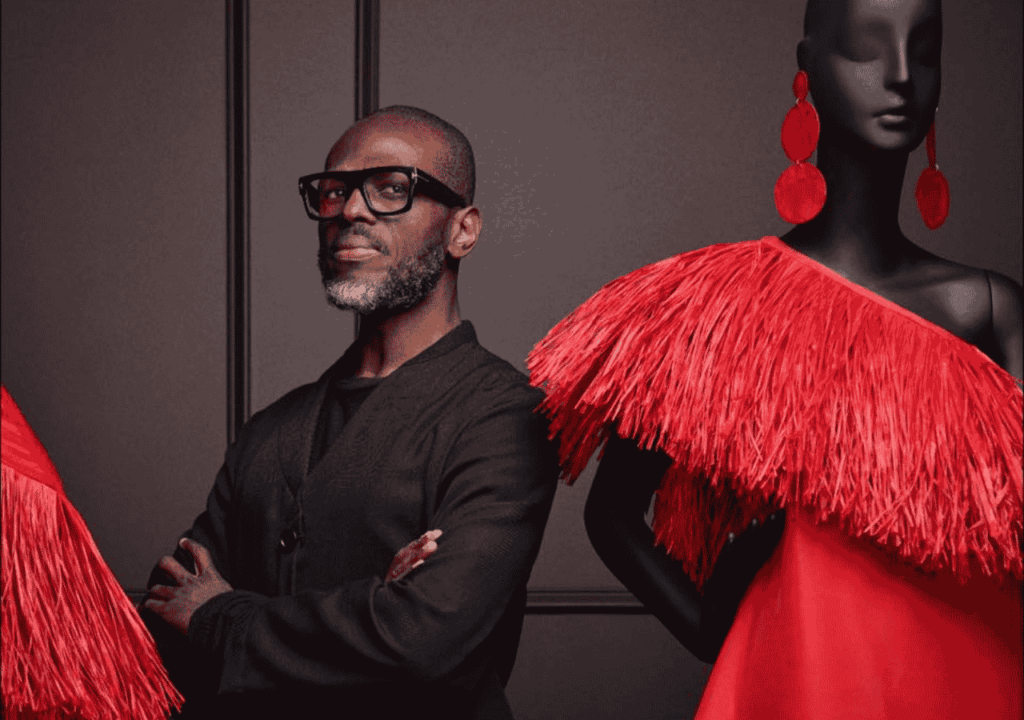
- Raffia — from Cameroon and Madagascar, dyed, fringed, layered. “Raffia is Africa’s sequins,” he said backstage in 2024. He likes taking a rustic material and giving it its titles of nobility without reaching for glitter.
- Faso dan fani from Burkina Faso, manjak from Senegal, Cape Verdean jacquards, Ivorian kita, Burkinabè kapok, Cameroonian tie-and-dye, hand-dyed cottons, embroidered offcuts of dyed bazin.
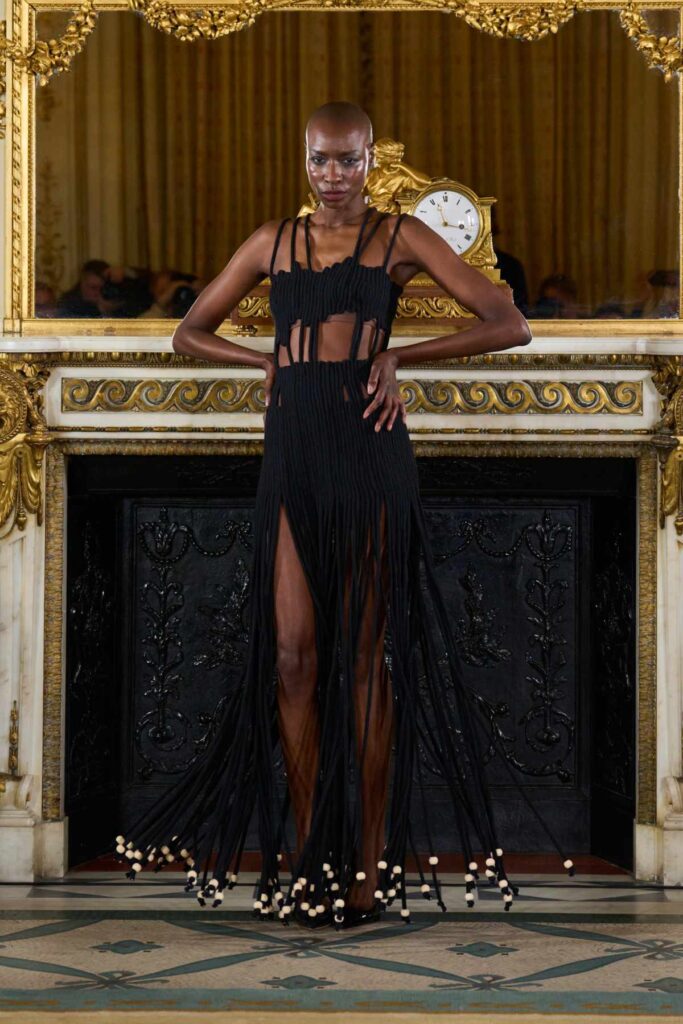
The move is technical before it is political. He applies the full grammar of the Paris atelier — bias cut, drape, internal structure, hand embroidery — to these materials, instead of treating them as decorative prints to be appliquéd onto a Western dress. The result is not a luxury boubou and not an evening gown with African trim. It is couture whose base material has changed.
And behind the aesthetics sits an economic argument he repeats in every interview: as long as African raw materials are processed off the continent, the problem remains. Local transformation would mean jobs, retained skills, stronger economies. At Lagos Fashion Week, launching UNESCO’s first continental report on the sector, he put it plainly — Africa has its own textile heritage, and African artisans deserve celebration.
He also, unusually, tells young Africans not to follow him. Paris is not the Eldorado they imagine, he says; the route across the desert and the sea kills people; the future is on the continent. Asked about the obvious contradiction — he left — his answer is unsentimental: he suffered to get here, and he cannot recommend it to anyone.
That the UNESCO numbers back him is worth noting. The continent produces cotton in 37 of 54 countries, exports some $15.5 billion in textiles a year, imports $23.1 billion in textiles, clothing and footwear, and hosts 32 national fashion weeks. The raw material leaves; the value is added elsewhere; the finished goods come back. Ayissi has built an entire couture practice as a small, stubborn counter-example to that flow.
VII. How the clothes actually work
Strip away the biography and the discourse, and there is a recognisable house signature — one that has tightened noticeably since 2020.
The silhouette is layered and monochrome-leaning, in jewel tones: coral against fuchsia, violet, turquoise, acid green. Tailored trouser suits and pencil skirts hold the structure; capes, columns, asymmetric trains and enormous knotted spans of fabric supply the drama. Ornament is generated from the garment’s own material — fringes teased along every seam, fabric discs buttoned onto bodices, cord stitched into graphic squiggles — rather than imported onto it. Gloves and oversized felt discs worn as earrings do the styling.
The seasons read as a body of work rather than a series of statements. Mbeuk Idourrou (AW2019) produced the fuchsia raffia-fringed cape now in the V&A. Ikorrok (FW2025) took its title from the Ewondo for “fallow,” an ode to regeneration in silk, hand-dyed cotton and wool felt. Bissakarak (SS2026) means “scribble”: lengths of cloth draped, knotted and wound around the body, with a final run of hand-painted, frayed ivory satin inspired by the designer’s first encounter with Rothko at MoMA. Ozouandam Ollat (FW2026-27) introduced all-over beading, a technique new to the house.
He names collections in Ewondo. Not one of them is translated on the invitation. That, too, is the argument.
VIII. A small house playing a long game
The romance of the story tends to obscure the arithmetic.
Imane Ayissi is a small independent company. There is no LVMH, no Kering, no Qatari fund. The business is run with Jean-Marc Chauve, a longtime friend who serves as managing director and brand manager, and who supplies the structure — narrative coherence, sustainability policy, commercial discipline — around an instinctive designer. Revenue comes from made-to-order couture for private clients, wearable “couture à porter,” accessories, and a genuinely useful red-carpet business.
The client list is more international than the “African designer” label implies: Zendaya, Angela Bassett, Lauryn Hill, Lashana Lynch, Aïssa Maïga, Rossy de Palma, Claudia Tagbo, Angélique Kidjo — who has worn the house to the Royal Albert Hall, to magazine covers, and into a Davido video — and a substantial Chinese constituency including Liu Shishi, Dilraba Dilmurat, Esther Yu and Liu Yuxin.
The fragility is equally real, and there was a perfect illustration of it in January 2026. Ayissi hurt his back a week before his couture show and could not attend. The collection went out anyway, in a salon at the Hôtel Meurice, staged as an old-fashioned couture presentation: Chauve and a single assistant dressing four models in front of the audience, one dress refusing to fasten, another fighting back, the clothing rack that formed the backdrop collapsing partway through. The models carried it off with charm and the reviews were warm.
It was, depending on how you read it, a charming throwback or a reminder that a house of this size is one bad week away from improvisation. Both readings are correct.
IX. The museum years
The most telling development of the last five years is also the least discussed: Ayissi is being institutionalised by museums faster than by the market.
- The Victoria and Albert Museum holds three of his works, in silk, hemp and raffia, made between 2017 and 2020. His raffia-trimmed fuchsia ensemble became one of the signature objects of the V&A’s landmark Africa Fashion in 2022.
- That exhibition then travelled — Brooklyn, Portland, Chicago, Melbourne, Montreal — before reaching Paris, at the Musée du quai Branly – Jacques Chirac, from 31 March to 12 July 2026, in an expanded version. His silhouette opens the route.
- In 2024–25 he received his first solo museum show: Imane Ayissi: From Africa to the World at SCAD FASH in Atlanta, curated by Rafael Gomes — 43 looks with their sketches and the designer’s own artworks, presented as the first solo exhibition devoted to an African couturier in an international fashion museum.
- In 2026 the Palais Galliera, the City of Paris fashion museum, acquired a piece for its permanent collection.
- He is an Officier de l’Ordre des Arts et des Lettres.
Museums are slower than magazines and considerably harder to lobby. When they move, they are usually recording something the market has not yet priced.
X. Three things to keep straight
He is not the only African designer in the fashion weeks. He is the first, and currently the only, sub-Saharan African on the haute couture calendar. The ready-to-wear calendars are a different story: South Africa’s Thebe Magugu and Lukhanyo Mdingi, Nigeria’s Kenneth Ize, French-Malian Mossi Traoré, Ladislas Mande’s LAD. And in couture, the Tunisian-born Azzedine Alaïa preceded him. Ayissi’s distinction is specific — couture, sub-Saharan, sustained — and it is diminished, not helped, by inflating it.
Guest membership is not the haute couture appellation. It is renewed each season. He has held it since 2020, which is its own kind of achievement, but it is not a permanent seat.
The label is also a cage. There is a standing risk that Ayissi is summoned only as “the African couturier” — booked for the Africa exhibitions, quoted in the diversity pieces, and less often judged on the plain question of whether the cut is good. He fights it in the only way available: by refusing to explain himself, keeping the collection names in Ewondo, and letting the construction argue.
XI. Grande Couture
On 18 June 2026 he published Grande Couture (Débats Publics, 252 pages) — a manifesto and autobiography whose title translates ozouandam ollat from Fang and Beti. He writes about what it means to create now: the limits of artificial intelligence in the design process, the value of the hand, the pull of social media, the environmental and social demands closing in on designers. Creation, he writes, was never a choice — it was self-evident. Le Monde Magazine, Le Figaro, TV5 Monde and France Inter all made room for him.
Three weeks later he sent his mother’s collection down a runway staged as a departure gate, and danced at the end of it.
There is an almost unbearable neatness to that ending. A man who learned to sew on his mother’s dresses names a collection “haute couture” in her language, dresses it as the airline she flew for, and finishes by dancing — which is what he was doing before any of it began, in Yaoundé, when nobody in Paris had heard of him and would not for another thirty years.
The lesson is not that talent wins. Talent frequently does not. The lesson is narrower and harder: he was rejected twice, kept showing in rented rooms for a decade, and turned out to be right about the fabrics. He simply outlasted the door.
Timeline
| Year | |
|---|---|
| 1968 | Born in Yaoundé. Father a champion boxer; mother the first post-independence Miss Cameroon and an Air Afrique stewardess. |
| 1980s | Ballet National du Cameroun; designer for Cameroon’s largest ready-to-wear workshop. |
| 1992 | Moves to Paris. Dances with Patrick Dupond; performs with Yannick Noah. |
| 1993 | First Paris show. |
| 1995 | Finalist, Mannequin Europe. Modelling career: Dior, YSL, Givenchy, Lanvin, Valentino, Cardin. |
| 2004 | Founds the Imane Ayissi label. |
| 2010 | Begins showing during couture week, off-calendar. |
| 2014–15 | Afro-Brazilian Museum, São Paulo, acquires pieces. |
| 2018–19 | Karralokga and Mbeuk Idourrou at the Mona Bismarck Foundation. |
| 2020 | Akouma. Joins the official couture calendar as a guest member, aged 52, after two rejections. |
| 2022 | Featured in Africa Fashion at the V&A, London. |
| 2024–25 | From Africa to the World, SCAD FASH Atlanta — first solo museum show. |
| 2025 | Ikorrok (FW). Officier de l’Ordre des Arts et des Lettres. |
| 2026 | Bissakarak (SS); Africa Fashion at the quai Branly; Palais Galliera acquisition; Grande Couture published; Ozouandam Ollat (FW26-27). |