

BRICS’s New Delhi summit showed a group big enough to rival the West economically — and divided enough to avoid saying so out loud
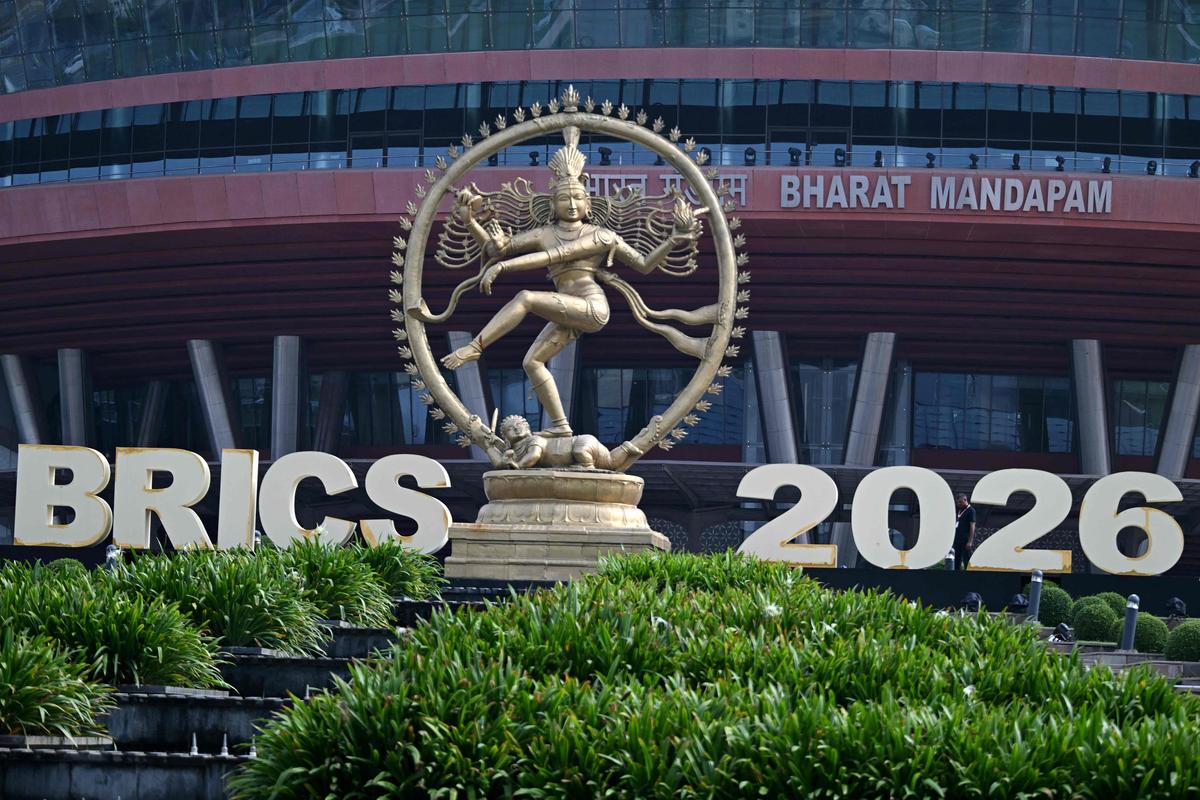
NEW DELHI — For two days in the Indian capital, the leaders of eleven nations that together generate 41 percent of the world’s economic output at purchasing-power parity and are home to nearly half of humanity sat down to issue a joint statement — and spent most of their effort agreeing on what not to say. The 18th BRICS Summit, hosted by Prime Minister Narendra Modi on September 12–13, 2026, under the banner “Building for Resilience, Innovation, Cooperation and Sustainability,” convened a bloc that includes both Tehran and Abu Dhabi, both Moscow and an India still nominally committed to non-alignment, at a moment when an American-Israeli war on Iran and the grinding conflict in Ukraine made almost any plain sentence a diplomatic risk. The resulting New Delhi Declaration found language vague enough for all eleven to sign. Whether that achievement amounts to unity, or merely its careful imitation, is the real story of this summit.
A bigger table, a blurrier map
BRICS began in 2009 as a caucus of Brazil, Russia, India and China — an acronym coined years earlier by a Goldman Sachs economist to describe fast-growing emerging markets, not a political project. South Africa joined in 2010, adding the final letter. The bloc’s character changed far more dramatically on January 1, 2024, when Egypt, Ethiopia, Iran and the United Arab Emirates became full members, followed by Indonesia on January 6, 2025 — the most recent country to complete accession. Saudi Arabia occupies a stranger category: Riyadh was invited on the same terms as the 2024 cohort and is listed as a member by both BRICS and the Indian government, but the kingdom has never formally confirmed its accession, a hedge widely read as Riyadh’s reluctance to complicate its security relationship with Washington.
A second, looser tier was created at the 2024 Kazan summit: nine countries — Belarus, Bolivia, Cuba, Kazakhstan, Malaysia, Nigeria, Thailand, Uganda and Uzbekistan — became “partner countries” on January 1, 2025, with Vietnam added on June 13, 2025, to bring the total to ten. The category carries no vote and, by the assessment of the Peterson Institute for International Economics, no clear definition of what partnership actually confers. Algeria, which lobbied hard for full membership in 2023, ended up on neither list. By India’s own count during its 2026 chairmanship, more than thirty additional governments have expressed some interest in joining some tier of BRICS — a queue that says as much about dissatisfaction with existing institutions as about BRICS’s own coherence.
| Category | Countries | Joined |
|---|---|---|
| Founding members | Brazil, Russia, India, China | 2009 |
| Full member | South Africa | 2010 |
| Full members (2024 wave) | Egypt, Ethiopia, Iran, United Arab Emirates | 1 January 2024 |
| Full member, accession disputed | Saudi Arabia | Invited 2024; unconfirmed by Riyadh |
| Full member (latest) | Indonesia | 6 January 2025 |
| Partner countries | Belarus, Bolivia, Cuba, Kazakhstan, Malaysia, Nigeria, Thailand, Uganda, Uzbekistan | 1 January 2025 |
| Partner country | Vietnam | 13 June 2025 |
The scale this produces is genuine. The International Monetary Fund’s April 2025 World Economic Outlook put the eleven members’ combined share of world output, measured at purchasing-power parity, at 40 percent in 2024 and a projected 41 percent in 2025 — well ahead of the G7’s roughly 28 percent. Measured in nominal dollars, the gap narrows sharply: an IMF-based analysis published by Visual Capitalist put BRICS+ nominal GDP at $31.7 trillion for 2025, against $57.5 trillion for the G7, or roughly 29 percent of the world economy — a reminder that the bloc’s headline PPP figure reflects lower price levels in its member economies as much as it reflects comparable purchasing power abroad. According to Indian government figures cited during its 2026 chairmanship, the eleven members hold 49.5 percent of the world’s population, some 3.9 billion people. Their weight in physical resources is, if anything, starker: the eleven produced an estimated 44 percent of the world’s crude oil in 2022, per the Energy Institute’s Statistical Review of World Energy (OPEC’s own bulletin puts the figure higher, at 47.6 percent), and BRICS members controlled roughly 82 percent of the world’s proven rare-earth reserves as of 2025, according to U.S. Geological Survey data — China alone holding 48 percent.
Who showed up, and who sent regrets
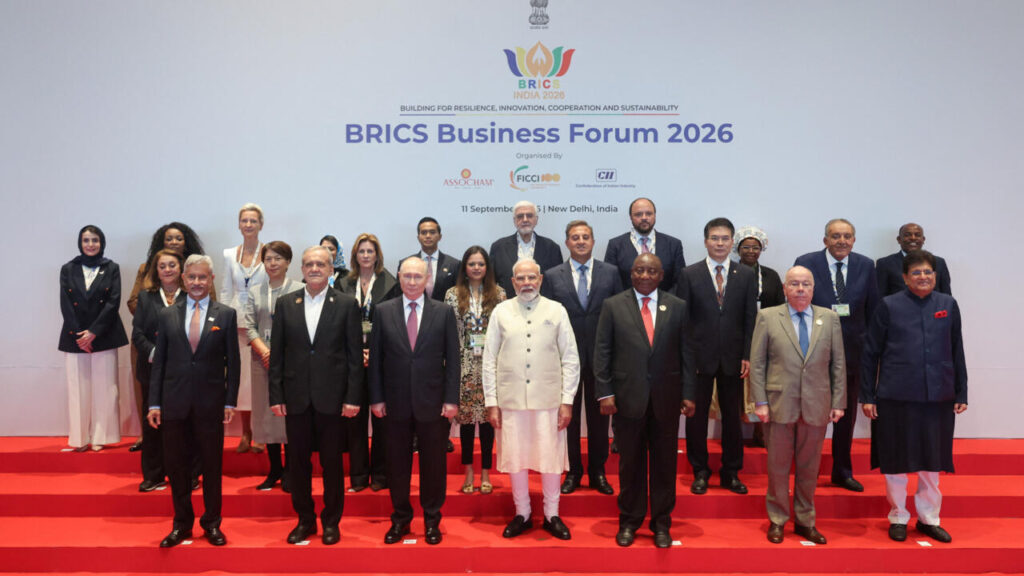
Modi, chairing BRICS since India assumed the rotating presidency from Brazil on January 1, hosted Vladimir Putin, who arrived on September 11, and Xi Jinping, who held a closely watched bilateral meeting with Modi aimed at thawing years of frost since the 2020 Galwan Valley border clash. Iran’s president, Masoud Pezeshkian, also attended in person and used the platform to press for wider use of national currencies in trade among members. Several of the bloc’s other heads of state sent lower-ranking delegations instead, part of what Bloomberg described as a deliberately “low-key” summit — India, mindful of the tensions its guests carry with them, avoided staging the kind of triumphant coming-out party the format might have invited.
The two days were not without friction. Xi skipped Modi’s gala dinner the evening of September 12; Indian television reported only that he had “returned to his hotel to rest,” with no official explanation offered. The crown prince of Abu Dhabi, representing the UAE, also missed the dinner, while Kazakhstan’s Kassym-Jomart Tokayev and Indonesia’s Prabowo Subianto did attend. None of this derailed the substantive Modi-Xi meeting held earlier the same day, but it underlined how personal and protocol frictions continue to run alongside genuine diplomatic engagement. Saudi Arabia’s continued refusal to confirm its own accession added a further note of ambiguity to the room. To extend its convening reach beyond its own membership, India also hosted, as guests, the sitting chairs of four other blocs: Burundi’s Évariste Ndayishimiye for the African Union, the Philippines’ Bongbong Marcos for ASEAN, Uruguay’s Yamandú Orsi for CELAC, and Bahrain’s King Hamad bin Isa Al Khalifa for the Gulf Cooperation Council.
What New Delhi actually agreed to
The New Delhi Declaration, adopted September 12, ran through a long list of institutional ambitions: comprehensive reform of the UN Security Council, with explicit note that no woman has ever served as UN Secretary-General and a call for greater representation from Africa, Asia and Latin America; “meaningful quota realignment” at the IMF under its 17th General Review of Quotas; endorsement of a Strategy for BRICS Economic Partnership 2030 and a new Investment Platform Study Group; and a scattering of smaller initiatives, from a BRICS Insurance Resilience Centre and an India-hosted Risk Lab in Gujarat’s GIFT City to a new Space Council and an agricultural research network. On energy, the declaration walked a careful line, acknowledging fossil fuels’ continuing role in emerging-market economies while backing a “just, orderly, equitable and inclusive” transition and emphasizing critical minerals and hydrogen standards — an agenda that plays to the strengths of resource-rich members like Russia, Brazil and the Gulf states.
The declaration’s more delicate work involved the wars its members are variously fighting, funding or condemning. On the Middle East, it expressed “deep concern” and urged “maximum restraint” without naming a single responsible party, folding criticism of strikes on “civilian infrastructure and peaceful nuclear facilities” into deliberately unattributed language — a formula that let Iran and the UAE, on opposite sides of the region’s fault lines, sign an identical text. On Ukraine, the word itself never appears; the declaration calls for dialogue while opposing “unilateral sanctions” not authorized by the UN Security Council, phrasing that tracks Moscow’s framing of Western sanctions considerably more closely than Kyiv’s. On Gaza, by contrast, the bloc spoke plainly, opposing forced Palestinian displacement and backing full UN membership for Palestine and a two-state solution on 1967 lines. On trade, it condemned “unilateral tariff and non-tariff measures” without naming the United States, whose tariff threats — including a mooted 100 percent levy floated by Donald Trump in late 2024 against any country backing a dollar alternative — hovered over the entire proceeding.
“BRICS is not against anyone,” Vladimir Putin told the summit, insisting Moscow remained “open to cooperation with countries around the world.” Modi, for his part, called the gathering a “coming of age” moment and urged the Global South to become a “rule-shaper” rather than a rule-taker in global governance.
De-dollarization: the myth and the mechanics
No claim about BRICS is more widely repeated, or more consistently overstated, than the idea that the bloc is on the verge of unveiling a common currency. It is not. Brazilian President Lula da Silva said flatly in February 2026 that there was “no proposal to create a BRICS currency”; the Kremlin issued a similar denial after Trump’s tariff threat; and at New Delhi itself, a senior Indian foreign ministry official, Sudhakar Dalela, said there was no shared-currency proposal “as of now.” The New Delhi Declaration does not mention a common currency at all, preferring language about “interoperable payment systems” and voluntary local-currency arrangements — what Indian officials this year have taken to calling “de-risking” rather than “de-dollarization,” a distinction meant to signal diversification away from dollar exposure rather than an attempt to replace it outright.
What is real is narrower and driven less by ideology than by sanctions. Bilateral trade between Russia and China, cut off from much of the dollar system by Western sanctions since 2022, is now settled almost entirely in rubles and yuan — more than 99 percent, according to Putin’s own account, corroborated by Chinese state media. China’s renminbi clearing network, the Cross-Border Interbank Payment System, had expanded to somewhere between 189 and 192 participating countries and regions by mid-2026, according to Central Banking magazine and China’s state news service — impressive reach, but reach that belongs to Beijing, not to BRICS as an institution. That distinction matters, because it exposes the bloc’s central monetary contradiction: any serious move away from the dollar currently means a move toward the yuan, and most members — India above all — are no more eager to trade dollar dependence for renminbi dependence. China’s economy, at roughly 19.6 percent of world output at purchasing-power parity in 2024, dwarfs every other member’s, an asymmetry that helps explain New Delhi’s caution on the subject since at least the 2025 Rio summit. Add persistent capital controls, thin currency convertibility outside China, and the absence of anything resembling a BRICS central bank, and the long-touted “BRICS Pay” settlement platform — conceived, like CIPS itself, as a hedge against dependence on the Belgium-based SWIFT messaging network that underpins most dollar transactions — remains, in the Declaration’s own careful wording, a project the bloc’s Payment Task Force “continues exploring” rather than a system in operation.
Africa’s seat at the table
South Africa, a member since 2010, was for over a decade the bloc’s only African voice; Egypt and Ethiopia joined as full members on January 1, 2024, and Nigeria and Uganda hold partner status since January 2025. Access to the bloc’s financial institutions moves on its own, slower timeline: Ethiopia only secured membership of the New Development Bank, BRICS’s answer to the World Bank, in July 2026 — a year and a half after joining BRICS itself, evidence that political accession and financial access are governed by two different processes on two different clocks. The NDB, founded in 2015, had approved roughly $39 billion in cumulative project financing by the end of 2024 according to its own figures, including a $10 billion COVID-19 emergency package and, this September, a fresh $1 billion urban-infrastructure loan to South Africa; bank president Dilma Rousseff, Brazil’s former head of state, said the NDB raised $16.1 billion in funding in 2024 alone.
For African governments, the appeal is straightforward: financing with less of the policy conditionality historically attached to IMF or World Bank lending, and a voice, however junior, in a forum increasingly setting its own global-governance agenda. South African President Cyril Ramaphosa told the summit that BRICS “represents half of the world’s population and 40 percent of its GDP,” casting the bloc’s aggregate scale as African leverage. Researchers tracking China’s financing role on the continent see a real risk running the other way: that African states trade dependence on Bretton Woods conditionality for a narrower dependence on Chinese capital and, increasingly, Chinese-controlled payment infrastructure — one asymmetry for another, rather than an escape from asymmetry altogether. Africa’s genuine point of leverage, control over critical minerals essential to the energy transition BRICS itself champions, remains a card the continent has yet to play collectively rather than country by country.
A counterweight, or just a chorus?
The gap between aggregate weight and collective agency remains BRICS’s oldest, least-resolved contradiction. Members have never agreed on the bloc’s basic purpose. Russia and China favor explicit friction with the Western-led order — Putin has likened the current international system to “classic colonialism” — while India, Brazil and South Africa insist on reform from within. “BRICS is not a counterpoint to the G7, nor the G20, nor against anyone,” Lula has said, language strikingly close to Putin’s own “not against anyone” at New Delhi — a sign, perhaps, that the rhetorical gap between the bloc’s camps has narrowed even where the underlying disagreement has not. The Peterson Institute for International Economics has pointed to the payment system’s slow crawl from “study the feasibility” at Kazan in 2024 to more study in 2026, and to Brazil’s own veto of Venezuela’s accession despite Russian backing, as evidence that BRICS members can agree on grievances far more easily than on remedies. The Sino-Indian relationship remains the bloc’s newest structural fault line: a substantive Modi-Xi meeting aimed at easing post-Galwan border tension coexisted, at the same summit, with Xi’s unexplained absence from his host’s dinner table.
Foreign Policy’s framing of the gathering as a test of whether BRICS is “losing its mojo” captures the ambivalence fairly. New Delhi did produce one real achievement: getting Iran and the UAE, on opposite sides of a live regional war, to sign the same text. It did not convert the bloc’s economic scale — 41 percent of world output at purchasing-power parity, half the planet’s population, close to half its oil and the overwhelming share of the minerals the energy transition will require — into anything resembling unified action, a shared institution with enforcement power, or a common position on either war dominating headlines the week its leaders met. BRICS in 2026 looks less like an emerging pole in a multipolar order than a standing, expanding negotiation among states that agree the current system shortchanges them and disagree, often sharply, on what should replace it. That may matter enormously in its own right — a forum where Beijing, Moscow, New Delhi, Brasília and Pretoria sit as nominal equals is itself without precedent — but it remains, for now, a description of a caucus rather than proof of a bloc capable of exercising power as one.

