

On April 14, 2026, the Institut Pasteur hosted an unprecedented event bringing together business leaders, scientists, and the Ministry of National Education around a shared ambition: shattering the glass ceiling before young girls even enter the workforce. At the heart of the initiative is the “Code F” programme — launched in October 2025 — whose rapid expansion signals a national strategy that is, at last, truly coordinated.
A Gathering Equal to the Challenge
The MEDEF did not choose its venue by chance. On Tuesday, April 14, 2026, France’s leading employers’ federation brought together at the Institut Pasteur the three key players in a collective response to the underrepresentation of women in scientific and technological careers: the business world, the school system, and the research community. The choice carried powerful symbolism: since January 2024, the Institut Pasteur has been led by Professor Yasmine Belkaid — the second woman to hold the position of Director General since the institution was founded by Louis Pasteur in 1887, and an internationally renowned researcher whose work centres on the relationship between microbes and the immune system.
Patrick Martin, President of the MEDEF, and Patricia Vialle, President of the MEDEF Women’s Network, had invited business leaders, education stakeholders, associations, and territorial networks to this unique gathering, designed to bring together all those working toward greater gender diversity in scientific, technological, and technical careers.
Alarming Numbers, an Economic Imperative
Behind the event lie figures that are difficult to ignore. Only 30% of engineering school students in France are women — a proportion that has fallen by three percentage points since 2022, while Morocco, for example, counts over 40% of female engineering students. Fewer than 30% of workers in the construction, industrial, and digital sectors are women. And only 15% of students taking engineering sciences as a specialisation in their final year of secondary school are girls.
The underrepresentation of women in these fields is not merely a question of social justice — it is a direct drag on France’s economic competitiveness. France will need to train 100,000 additional engineers and technicians per year by 2035, according to the Institut Montaigne. And achieving gender parity in innovation sectors could drive a 70% increase in productivity, according to economist Xavier Jaravel (2025).
These figures shaped the tone of every speech delivered that afternoon. As Patricia Vialle put it in her opening remarks: “What we are building today is the economy of tomorrow. And that economy cannot afford to waste half of its talent.”
Code F: An Ambassador Network Built to Change Minds From Middle School Onward
The centrepiece of the strategy presented that day is the “Code F” programme, launched on October 15, 2025, at the Stade Vélodrome in Marseille, on the occasion of the UPE13 Entrepreneurs’ Forum, just ahead of the WorldSkills national trades competition.
Code F is a MEDEF initiative, placed under the high patronage of the Ministry of National Education, Higher Education and Research, and developed in partnership with the professional networking platform My Job Glasses. Its aim is to feminise scientific, technical, and technological careers by working at the middle- and high-school level to break down stereotypes and inspire vocations among young girls.
The mechanism is tangible: a network of over 1,300 ambassadors — professionals, entrepreneurs, and students — share their career stories with classes in secondary schools across France, to demonstrate that girls have every right to a place in innovation and the jobs of the future. The My Job Glasses platform, free and secure, allows teachers to find an ambassador in their department and contact them directly to arrange a classroom visit.
Integrated into the Ministry of National Education’s “Girls and Sciences” collective, Code F uses real-life testimonials delivered in classrooms to shift students’ perceptions of scientific careers as early as middle school.
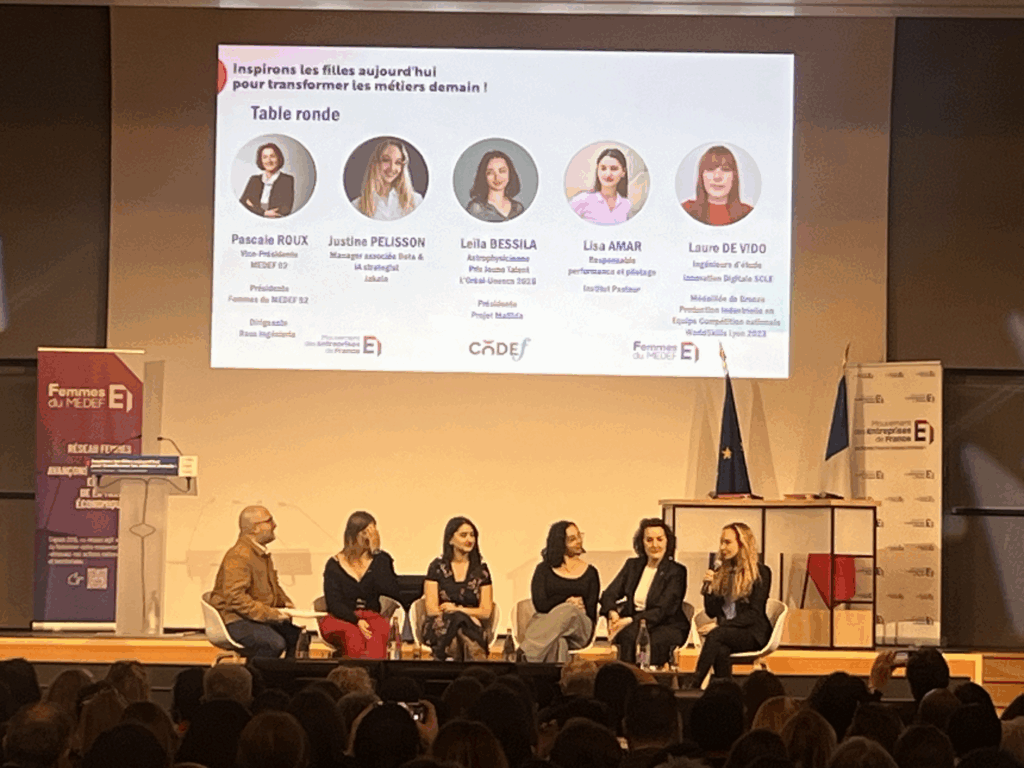
Voices That Carry: Key Speeches of the Day
Virginie Fauvel, CEO of Harvest and godmother of the Code F programme, opened the official session with a personal account of her career in tech and finance. Consistent with her positioning since the programme’s October launch, she underscored the need to open up possibilities long before young people face their first major academic choices: “You don’t choose a career you’ve never seen. Our role as ambassadors is to make visible what once seemed out of reach.”
Patricia Vialle, for her part, stressed the need to transform collective imaginations in order to open new professional pathways for young women. In her address, she outlined the architecture of the MEDEF Women’s Network, which she now chairs: “We are not here to open doors on their behalf. We are here to show them these doors exist — and that they belong to them.”
Yasmine Belkaid, Director General of the Institut Pasteur and the day’s most emblematic presence, spoke at the close of proceedings to remind the audience that the fight for gender diversity in science is also a matter of excellence. She — who became, from 2024 onward, only the second woman to lead the Institut Pasteur in more than a century of history, after a career that began in Algiers and continued at the US National Institutes of Health — lent the event a particular resonance: “Science needs every mind available to it. And minds have no gender.”
Three Roundtables: From Inspiration to Action
The afternoon was structured around three interactive roundtable discussions: women’s career paths in scientific and technological fields; how to become a Code F ambassador; and best practices for supporting young women from school orientation all the way through to employment.
Conversations highlighted several key levers: dismantling stereotypes within the school system, rethinking HR processes in recruitment, and the need to value a vocational engineering qualification just as much as a grande école degree — a clear signal of inclusivity in a debate that too often focuses solely on elite institutions.
A Three-Year Convention to Cement the Commitment
The institutional highlight of the day came in the late afternoon. Édouard Geffray, Minister of National Education, and Patrick Martin, President of the MEDEF, signed a three-year cooperation agreement, designed to be rolled out territory by territory, school district by school district, with particular attention paid to vulnerable populations.
The agreement moves well beyond the symbolic. By embedding Code F within a formal institutional framework, it gives the programme the structural backing needed to deploy its ambassador network in every department across France.
The MEDEF Women’s Network: A Documented Rise
Founded in 2019, the MEDEF Women’s Network was created to promote the feminisation of leadership bodies and to increase the visibility of women business leaders across France. Initially launched at the national level, it has been expanding into MEDEF’s territorial branches since 2021, and today brings together 35 territorial networks committed to gender diversity.
Results are beginning to show: more than 40% of the MEDEF’s national employer mandates are now held by women business leaders, and women account for 23% of all MEDEF members while occupying 37% of territorial mandates. Figures that remain short of genuine parity — but that point to a real and accelerating momentum.
Save the Date
The MEDEF has already announced its next major gathering: August 27, 2026. In the meantime, Code F continues its rollout across every academy and territory in France. To join the programme or find an ambassador near you: code-f.org.