


A scored ranking of ten Central African banks on SME and young-entrepreneur finance — and an account of what the score cannot see
No bank in Central Africa publishes the five figures that would settle the question: approval rate, median ticket size, share of the loan book held by firms under three years old, share disbursed without collateral, time to decision. Any “top 10 banks for SMEs” presented as a measurement is therefore a ranking of press releases. This one is built differently — ten institutions scored on four weighted criteria, every point sourced and dated, with the grid published so readers can contest it. Afriland First Bank leads; Cameroon’s largest lender ranks ninth.
Why this ranking had to be built differently
Start with the disqualifying fact. Not one bank in Central Africa publishes the five figures that would allow a genuine performance ranking on SME finance: the share of its corporate loan book held by firms under three years old, its SME loan approval rate, its median SME ticket size, the share of disbursements made without real security, and its median time from complete file to decision.
That absence is not incidental. It means any “top 10 banks for SMEs” presented as a measurement is a fabrication — an ordering of press releases dressed as data. Readers should treat unsourced league tables of this kind, including those circulated at conferences and award ceremonies, as marketing.
What can be done honestly is different, and it is what follows. This ranking scores ten institutions against four weighted criteria built only from public, dated, verifiable evidence. It measures demonstrated lending capacity, externally validated SME funding, documented schemes for young and first-time entrepreneurs, and structural fitness of the business model. It does not measure outcomes, because outcomes are not disclosed. The grid is published in full below, along with the list of what it cannot see, so that any reader can contest a score by contesting its source.
The scoring grid
| Criterion | Weight | What it captures | Evidence base |
|---|---|---|---|
| A. Demonstrated lending capacity | 25 | Does the institution actually lend at scale? Share of new credit distributed; balance sheet size | BEAC report on lending rates, Q1 2026; Jeune Afrique ranking of Central African banks, 2025 financial year |
| B. Externally validated SME funding and risk sharing | 30 | Dedicated SME lines and guarantees signed with development finance institutions — the strongest available proxy, because such facilities carry covenants, reporting obligations and third-party due diligence that a press release does not | IFC, Proparco, British International Investment, African Guarantee Fund, Islamic Development Bank, AfDB, FPM SA announcements |
| C. Documented youth, first-time and women entrepreneur schemes | 25 | Named programmes with published terms or beneficiary counts; participation in national youth guarantee schemes; unsecured lending offers | Bank and ministry announcements, dated |
| D. Business model and proximity | 20 | Microfinance or community origin; network beyond capital cities; decision speed; sector specialisation | Corporate histories and published operating data |
Criterion B carries the heaviest weight deliberately. A development finance institution line is the only signal in this market that has been independently underwritten: IFC, Proparco and the African Guarantee Fund conduct their own due diligence, impose reporting, and can withdraw. A programme announced at a trade fair carries no such discipline.
The ranking
| # | Bank | Country | A/25 | B/30 | C/25 | D/20 | Total |
|---|---|---|---|---|---|---|---|
| 1 | Afriland First Bank | Cameroon | 22 | 27 | 22 | 19 | 90 |
| 2 | Rawbank | DR Congo | 25 | 30 | 15 | 15 | 85 |
| 3 | Equity BCDC | DR Congo | 23 | 25 | 19 | 16 | 83 |
| 4 | BGFIBank Group | Gabon | 19 | 20 | 21 | 12 | 72 |
| 5 | Ecobank Cameroon | Cameroon | 16 | 15 | 21 | 17 | 69 |
| 6 | CCA Bank | Cameroon | 20 | 16 | 12 | 18 | 66 |
| 7 | BCEG | Gabon | 6 | 20 | 18 | 17 | 61 |
| 8 | La Régionale Bank | Cameroon | 10 | 14 | 15 | 18 | 57 |
| 9 | General Bank of Cameroon | Cameroon | 25 | 10 | 8 | 12 | 55 |
| 10 | Trust Merchant Bank / KCB Bank DRC | DR Congo | 18 | 10 | 9 | 16 | 53 |
The case for each ranking
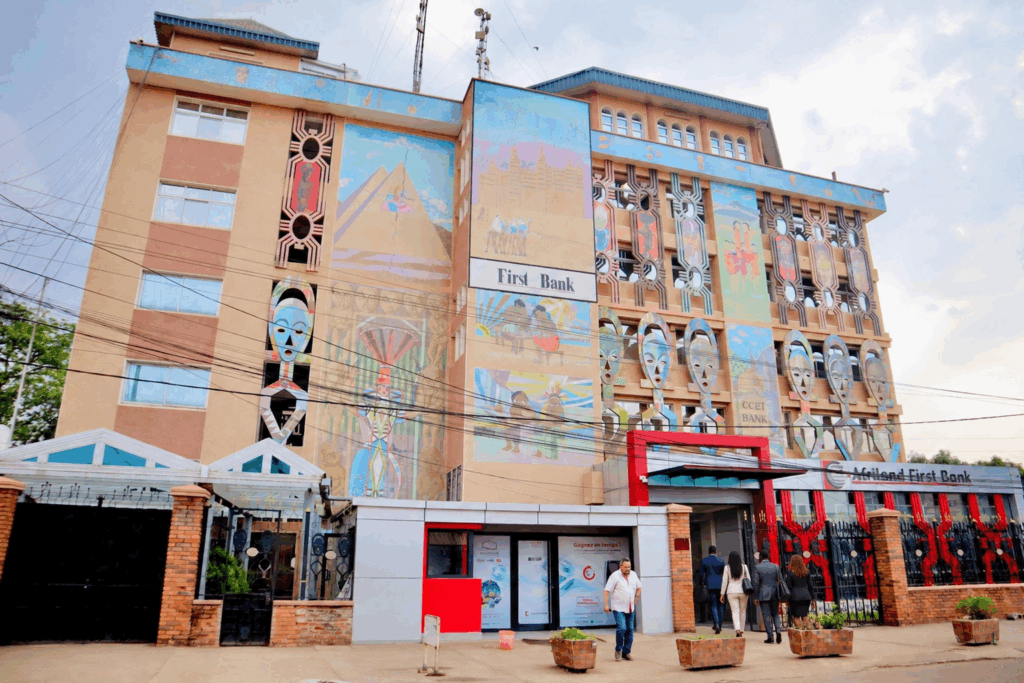
1. Afriland First Bank (Cameroon) — 90
The only institution in the region that has built a structural answer to the collateral problem rather than a programme around it. The Mutuelles Communautaires de Croissance (MC²) network has the village community supply the capital and run the micro-bank, with Afriland providing technical supervision and refinancing — the information problem solved through social proximity instead of security interests. The fullest public data, from 2015, indicate about 105 units, some XAF 145 billion injected over two decades, claimed repayment rates near 85% and rates capped around 15%. That vintage is this ranking’s weakest single source and Afriland should be pressed to update it.
The recent record is better documented: an IFC facility of USD 60 million (XAF 36.4 billion) in April 2025 for SMEs; XAF 33 billion raised from the Islamic Development Bank for SMEs; a XAF 5 billion SME credit line guaranteed by the African Guarantee Fund; XAF 1,200 billion extended to enterprises in 2025 on a balance sheet of about XAF 2,550 billion; fourth-largest lender in Cameroon in Q1 2026 with 13.48% of new credit; roughly 100 branches including rural locations; and 40 sponsored SME stands at PROMOTE 2026.
No other bank in the region combines a diversified DFI funding base, a rural network, and a proprietary community-lending model.
2. Rawbank (DR Congo) — 85
The largest bank in Central Africa (USD 6.19 billion balance sheet, first in Jeune Afrique’s 2025 ranking) and the author of the region’s single largest SME transaction: USD 265 million closed in March 2026, led by IFC — USD 165 million senior (IFC 50, Proparco 50, British International Investment 25, the OPEC Fund 20, eco.business Fund 20) plus a USD 100 million risk-sharing facility with IFC covering 50% — targeting at least 1,500 additional SMEs over four years. That combination of long-dated funding and genuine risk transfer is what the rest of the region lacks, and it earns a maximum score on criterion B.
It scores lower on youth: the Lady’s First programme for women entrepreneurs is well established, with IFC WIN training and an annual ambassador challenge, but publishes no beneficiary numbers, and no dedicated youth scheme is documented. Congolese-owned, which matters in a market where three of the four largest banks are foreign-controlled.
3. Equity BCDC (DR Congo) — 83
Second by balance sheet (USD 5.08 billion), with the region’s most explicit SME and agricultural positioning and a provincial network more balanced than its peers’. A USD 15 million partnership with FPM SA signed in August 2025 for MSME access to finance; a renewed Proparco facility; an IFC collaboration since 2023; and inclusion in the African Guarantee Fund–Equity Bank framework signed in May 2025 — USD 500 million intended to unlock USD 1 billion, explicitly targeting youth- and women-led businesses, with the DRC among the five countries covered.
It is the only bank in the ranking with a documented youth-specific partnership: the collaboration with FSPEEJ on financing young entrepreneurs. Its parent, Equity Group, is the continent’s reference case for a microfinance institution that became a full bank without losing its client base — the model La Régionale and CCA Bank are attempting at smaller scale.
4. BGFIBank Group (Gabon) — 72
Carries the region’s broadest guarantee umbrella: a EUR 50 million portfolio guarantee line with the African Guarantee Fund, signed in August 2022, covering SME lending across twelve countries of presence and including the AFAWA window for women entrepreneurs.
Its strongest youth credential is the most precise in CEMAC. BGFIBank Cameroon signed a FOGAJEUNE convention with the Ministry of Youth in May 2024 providing two windows: direct financing up to XAF 25 million at 0% or 8%, and a guarantee window up to XAF 100 million for entrepreneurs trading three years or more, including diaspora joint ventures with residents, prioritising agriculture, the digital economy, industry and craft, and technological innovation. Published ceilings and published rates are rare enough in this market to count.
Sixth-largest lender in Cameroon in Q1 2026 (8.61%). It loses points on proximity: a corporate and sovereign DNA, with limited retail reach into the segments this ranking concerns. Its May 2026 listing on BVMAC — which tripled regional market capitalisation from XAF 479 billion to XAF 1,658 billion — is a real contribution to the region’s capital markets, though not to SME credit directly.
5. Ecobank Cameroon — 69
Named Bank of the Year 2025 for Cameroon by The Banker in December 2025, for the second consecutive year, on criteria weighted towards sustainability and community impact rather than financial performance alone.
The Ellevate programme is the best-documented women’s entrepreneurship scheme in CEMAC: more than 2,000 women-led businesses supported since June 2024 and XAF 4.8 billion in loans, with unsecured lending up to USD 50,000. Two operational metrics stand out because almost no competitor publishes them: credit application processing cut from six days to three, and account opening time reduced by 65%. For an SME, decision speed is a real price. More than 1,200 Cameroonian SMEs are registered on the group’s Single Market Trade Hub, which addresses the market-access constraint rather than the credit constraint — an unusual and useful angle.
It scores modestly on capacity (seventh lender in Cameroon, 6.23% in Q1 2026; XAF 221 billion to the economy at 31 January 2026) and on criterion B, where no recent Cameroon-specific DFI SME facility is publicly documented.
6. CCA Bank (Cameroon) — 66
Founded in 1997 as a savings and credit cooperative in Bafoussam, a universal bank since 2018 — the clearest case in CEMAC of microfinance DNA scaled up. Balance sheet of nearly XAF 1,100 billion at end-2025, up 31.4% year on year; net profit XAF 21.8 billion; equity doubled to XAF 61 billion. Fifth-largest lender in Cameroon in Q1 2026 with 10.97% of new credit — ahead of several far older institutions. An AfDB trade finance facility supports its SME clients, and it is preparing regional expansion under CEMAC’s single licence.
It ranks below Ecobank and BGFI on this grid for one reason only: it publishes no dedicated youth or first-time-entrepreneur scheme. Its upcountry base in the West region gives it the informational advantage; it has not yet converted that advantage into a documented offer for the segment.
7. BCEG — Banque pour le Commerce et l’Entrepreneuriat du Gabon — 61
The only bank in the ranking created for this purpose. Small — which costs it heavily on criterion A — but structurally the best-covered: the Société de Garantie du Gabon covers 50% of its SME loans, the highest documented coverage ratio in the region, and BGFIBank Group has provided XAF 4 billion in support. Roughly 200 entrepreneurs trained through its “Atelier PME” programme in 2025, with an explicit mandate to bring informal-sector operators into the banking system, and new outlets opened in the Oloumi industrial zone and at the Akanda and Petit-Dubaï markets.
This is the institution to watch. If its loss experience holds over a full cycle, it becomes the regional proof of concept for partial public guarantee at scale — the Tier 1 mechanism described in the main article.
8. La Régionale Bank (Cameroon) — 57
A savings and credit institution since 1993, a universal bank since 2022, operating a hybrid agricultural and digital model. IFC extended XAF 3 billion (USD 5 million) in June 2023 with at least 25% earmarked for women and women-led businesses, alongside advisory services to strengthen its risk management framework.
Small scale caps its score. But on criterion D it is among the highest in the ranking: agricultural specialisation plus microfinance origin plus digital onboarding is, on paper, the best model fit in the region for young rural entrepreneurs without collateral. The question is whether it can reach scale before the XAF 25 billion minimum capital requirement forces consolidation on it.
9. General Bank of Cameroon (formerly Société Générale Cameroun) — 55
The largest lender in Cameroon — 17.64% of new credit in Q1 2026, XAF 235.47 billion — which earns a maximum score on capacity, and the clearest illustration of why capacity alone should not determine such a ranking.
The Cameroonian state acquired 58.08% of the bank’s capital on 12 May 2026 and renamed it. Documented SME support exists, but no recent DFI SME facility is public, no dedicated youth scheme is documented, and the ownership transition makes forward commitments hard to assess. Its trajectory over the next eighteen months is one of the more consequential open questions in CEMAC banking: a state-controlled market leader could become the region’s main SME lender, or the next entry in the list of politically directed lenders that the main article catalogues.
10. Trust Merchant Bank / KCB Bank DRC — 53
Fifth-largest bank in Central Africa (USD 1.78 billion), acquired by Kenya’s KCB Group, with more than 70 branches — among the widest networks in the DRC — and the Pepele Mobile platform, one of the country’s earliest bank-led financial inclusion vehicles.
It enters the ranking on reach rather than on documented SME commitment: no DRC-specific SME facility or youth scheme is publicly documented, and the KCB integration is recent. Reach is not nothing — in a country where 78% of credit is concentrated in Kinshasa and Haut-Katanga, a branch network outside those two poles is itself a scarce asset.

What this ranking does not measure
Stated plainly, so that no reader mistakes its scope:
- It does not measure how much of each bank’s loan book actually reaches SMEs. No bank discloses it.
- It does not measure approval rates. A bank that receives 1,000 SME applications and approves 30 scores identically here to one that approves 300.
- It does not verify that DFI money reached SMEs. Criterion B records facilities signed, not loans disbursed to end borrowers. The gap between the two is, in this region, unknown.
- It does not measure price. BEAC data show fees and commissions accounting for 31.9% of the all-in effective rate borne by SMEs in Q1 2026. Bank-level pricing is not published.
- It does not measure SME portfolio quality. Regional non-performing loans stood at 17.4% at end-March 2025; the bank-level and segment-level breakdown is not public.
- It does not measure the quality of non-financial support. Counting trained entrepreneurs says nothing about what the training changed.
Geographic bias must also be declared. Nine of the ten entries are Cameroonian or Congolese, because those are the two markets where bank-level data are published. Chad, the Central African Republic, Equatorial Guinea and São Tomé and Príncipe are absent — not because their banks do nothing, but because nothing about what they do is documented. Any reader with sourced evidence on those markets should send it; the grid is designed to absorb it.
Why Angola sits outside the table
Angola is deliberately excluded, and the reason is analytically interesting.
Since 2020, the National Bank of Angola’s Aviso 10 has obliged banks to extend credit to the real economy at capped rates — 7.5% a year for investment and 10% for raw materials, inputs and factoring — with fines for non-compliance. The IMF notes these rates are roughly three times cheaper than conventional bank operations. The scheme now accounts for about 70% of the credit stock to non-financial corporations, roughly 3.8 trillion kwanza (about USD 4.2 billion) at end-2025, out of a total that grew from 3.1 to about 5.5 trillion kwanza.
The mechanism produces volume. It does not produce depth: private-sector credit in Angola stood at 6.2% of GDP in 2024, the lowest in this study’s sample and roughly six times below the SADC average.
The consequence for this ranking is methodological. Under a compulsion regime, a bank’s lending to SMEs cannot be read as commitment — it is compliance. Scoring Angolan banks on the same grid would credit them for obeying a regulation. The wider lesson is the one the main article argues: forcing the volume without repairing the four pillars of bankability produces disbursement, not intermediation.
The ranking that should replace this one
This table exists because the better one cannot yet be built. It can be, and quickly — it requires no new data collection, only disclosure of figures every bank already computes internally for its own risk committee.
Five numbers, published annually, would make every ranking of this kind obsolete, including this one:
- Share of the corporate loan book held by firms less than three years old.
- SME loan approval rate — applications accepted over applications filed.
- Median SME ticket size. The median, not the mean, which a handful of large files distorts.
- Share of disbursements made without real security, or with third-party partial guarantee.
- Median time from complete file to credit decision.
COBAC could require them in the standard reporting template at negligible cost. Until it does, the region will keep ranking its banks on what they announce rather than on what they do — and banks that genuinely serve the segment will keep receiving the same credit as those that merely publicise it.