


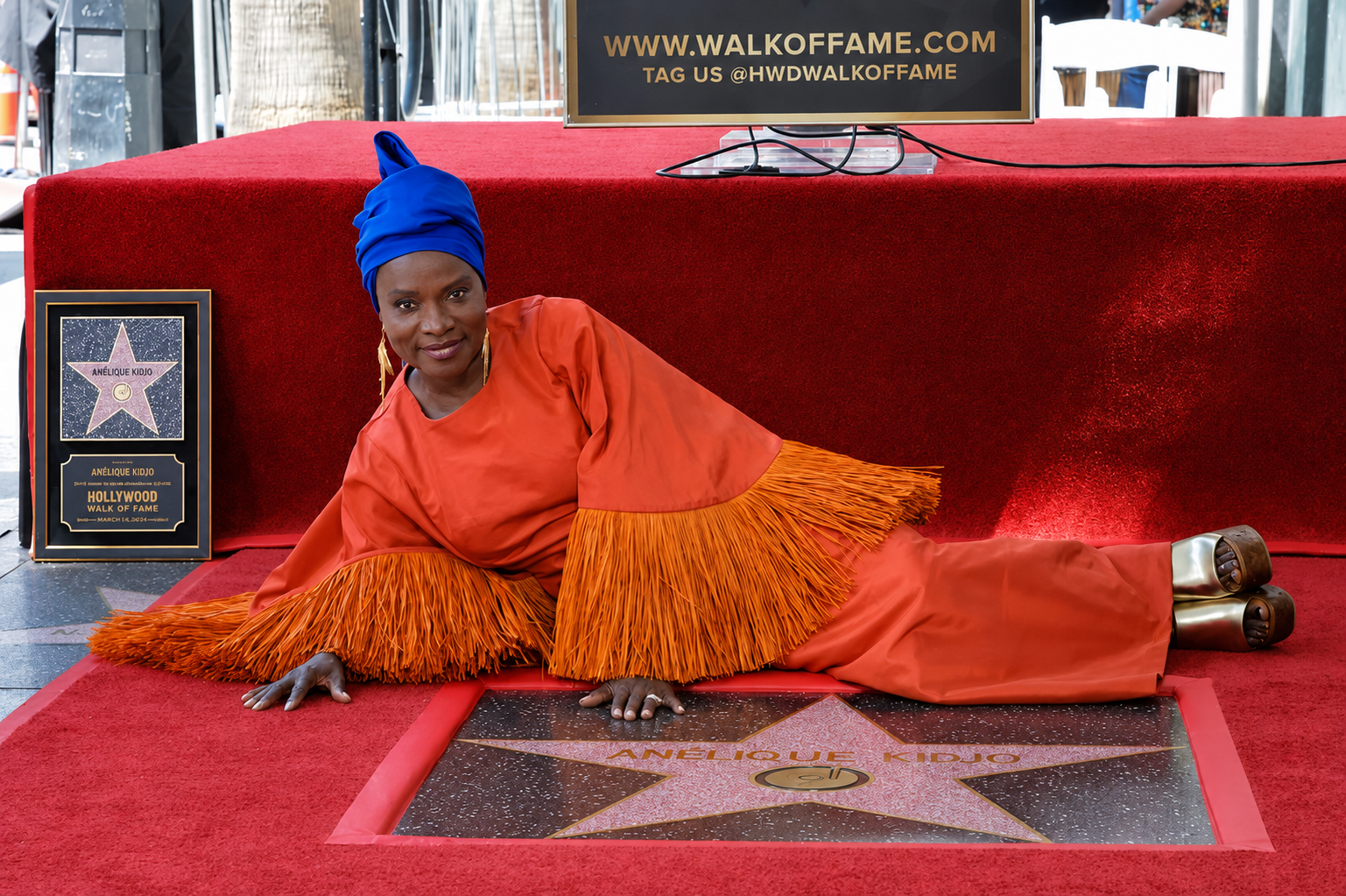
Angélique Kidjo, from Ouidah to Hollywood Boulevard
Los Angeles, August 18, 2026
It took forty-three years to travel from a stage in Cotonou to a stretch of pavement on Hollywood Boulevard. On August 18, 2026, under the palm trees across from the Roosevelt Hotel, at 7011, Angélique Kidjo unveiled the 2,854th star on the Walk of Fame, in the recording category. The first African artist. The first Black African. She is 66, holds five Grammy Awards and some twenty albums — and she began by saying no.
That is the detail the press releases leave out. Before the awards, before Philip Glass and Pharrell Williams, there was a refusal, spoken in Benin in the early 1980s by a twenty-year-old singer, and it cost her country.
Ouidah, Cotonou: born singing
Angélique Kpasseloko Hinto Hounsinou Kandjo Manta Zogbin Kidjo was born on July 14, 1960, in Ouidah, a former slave-trading port on the Gulf of Guinea, weeks before Dahomey’s independence. She was the seventh of ten children. Her father was a postal worker and musician; her mother, Yvonne, a choreographer who ran a theater company — a progressive woman in a setting that was not. “She was born singing,” her father used to say.
She was pushed onstage at six by her mother. As a teenager she recorded an adaptation of Miriam Makeba’s “Les Trois Z” for national radio, and the whole country heard it. By nineteen she was a star. She was also asthmatic, and a girl — two reasons, in the Benin of that era, to stay in her place. She did not.
1983: “Ready for the Revolution”
Since 1974, Benin had lived under Mathieu Kérékou’s Marxist-Leninist regime. Culture was a branch of the state: you sang for the Revolution or you did not sing. The official slogan — Ready for the Revolution, the struggle continues! — was meant to come out of every mouth. Kidjo never sang it. She invokes a principle handed down by her father: an artist’s neutrality is the condition of an artist’s freedom.
She described the tipping point to the Belgian daily La Libre this month. It was a command performance at a summit of West African heads of state. The stage had been built high; the leaders watched from below. The arrangement placed her literally above them and, symbolically, in their service. The disgust was immediate. Her parents then set money aside for a year to buy her a plane ticket.
She left in 1983. “Exile is no stroll,” she would say later. “If you don’t have freedom at home, you go looking for it elsewhere.”
Paris: two years of appetite and a stack of rejections
In Paris she worked to pay her tuition and enrolled at CIM, a jazz school. She devoured everything she had not been allowed to hear: Bashung, Higelin, Nougaro, Gainsbourg, the classical repertoire. One day in class she argued that Ravel’s Boléro rests on an African rhythmic principle — a repeated figure, a slow accumulation of tension. She was told she was wrong. She would record the Boléro thirty years later.
Those years produced a conviction she has never abandoned: back in Benin, she has said, she had been taught to understand the West more thoroughly than her own culture. And she discovered the mirror image of that ignorance in Europe.
At CIM she met Jean Hebrail, the musician who would co-write most of her work and become her husband. She sang backup, then fronted Pili Pili, the African jazz group led by Dutch pianist Jasper van ‘t Hof. And she sent out demos.
Everywhere. Nothing came back. Accepting the Polar Music Prize in Stockholm in 2023, she put it plainly: she had sent her music to every record company in Paris, and no one cared. It was the Senegalese activist Mamadou Konté who passed the tape to a man living in Jamaica: Chris Blackwell, founder of Island Records, the label that broke Bob Marley. He signed her on the spot.
A striking symmetry: forty years later, Blackwell and Kidjo received the same Polar Music Prize, in the same year, on the same stage.
Building bridges — in both directions
Logozo (1991) and then Ayé (1994), with the hit “Agolo,” established her internationally. But the core of her work follows a thesis: the music of the Americas is a debt owed to Africa, and the debt has to be read back on location. Hence a methodical trilogy — Oremi (1998) on African-American soul, Black Ivory Soul (2002) on Bahia, Oyaya! (2004) on the Caribbean.
The boldest move came later. In 2018 she recorded Remain in Light in full, the 1980 Talking Heads album that was itself built on West African polyrhythms. She did not cover it; she repatriated it. It is a critical act as much as a musical one, and probably the record that will last.
Along the way she has sung with Alicia Keys, Peter Gabriel, Carlos Santana, Herbie Hancock, Yo-Yo Ma, Bono, Burna Boy and Davido. Philip Glass wrote Ifé: Three Yorùbá Songs for her. Five Grammys: Djin Djin (2007), Eve (2014), Sings (2015), Celia (2019, a tribute to Celia Cruz — another exile), Mother Nature (2021). She sings in eleven languages and is still adding to the list.
Some of her stages are not concerts. In November 2018, beneath the Arc de Triomphe, before the heads of state gathered for the centenary of 1918, she sang “Blewu” in Ewe — for the African soldiers who died in a war that was not theirs. In 2021 she opened the Tokyo Olympics. In 2024 she sang “Jerusalema” at the reopening of Notre-Dame de Paris.
Batonga: a made-up word that became a foundation
The word did not exist. As a teenager, mocked by boys who thought school was no place for a girl, she threw a nonsense word back at them — meaningless, just enough to end the argument. Batonga.
In 2006 she gave the name to a foundation devoted to educating and empowering girls across Africa. She has been a UNICEF Goodwill Ambassador since 2002, and is a fixture at Davos, on panels, and in the field. At the Hollywood ceremony, Willem Dafoe made a point of saying this was “not a token celebrity involvement; it is an extension of what she does with her music.”
What they say about her
“In Africa’s new morning, Angélique Kidjo is the warmth of the rising sun.” — Bono, quoted in the 2023 Polar Music Prize citation
“The only thing bigger than Angélique Kidjo’s voice is her heart.” — Bill Clinton, on the back cover of Spirit Rising
“She is, without a doubt, the hardest-working woman in show business.” — Willem Dafoe, Walk of Fame ceremony, August 18, 2026
“Your work continues to remind us that music is more than entertainment; it’s connection.” — Harvey Mason Jr., CEO of the Recording Academy, same ceremony
“She constantly explores and challenges.” — Marie Ledin, managing director of the Polar Music Prize
Desmond Tutu wrote the foreword to her 2014 memoir Spirit Rising; Alicia Keys wrote the introduction. Time named her one of the hundred most influential people in the world in 2021.
One reservation, because an honest portrait has one
Not everyone applauds. Some critics — often African ones — fault Kidjo for a sound smoothed out for Western world-music circuits, and for an ambassadorial posture (the UN, Davos, the majors) that makes her a better emblem of a consensual pan-Africanism than of the continent’s actual working scenes. The “Mama Africa” label, inherited from Makeba, is contested on its own terms: it flattens a continent into a single exportable figure.
These objections deserve a hearing. They do not cancel what the career demonstrates: that a singer who refused to perform for a regime, who left with nothing and was turned away by every label in a capital city, spent forty years forcing African music to be treated as a source rather than a backdrop.
HOPE!!
HOPE!!, her first solo album in five years, came out on April 24, 2026, on Parlophone/Warner. Sixteen tracks, five years in the making, dedicated to her mother Yvonne, who died in 2021 — the woman who had pushed her onstage at six. Pharrell Williams produced three songs; Nile Rodgers, Davido, Ayra Starr, Quavo, Charlie Wilson, PJ Morton, The Cavemen and the Soweto Gospel Choir all appear. She wanted, she has said, to put some fire back in people’s hearts.
On Tuesday, at the microphone on Hollywood Boulevard, she did not thank an industry. She settled a matter of historical accounting:
“We Africans don’t know what we’ve given to the world, what we continue giving to the world; without us there’s no music possible on this planet.”
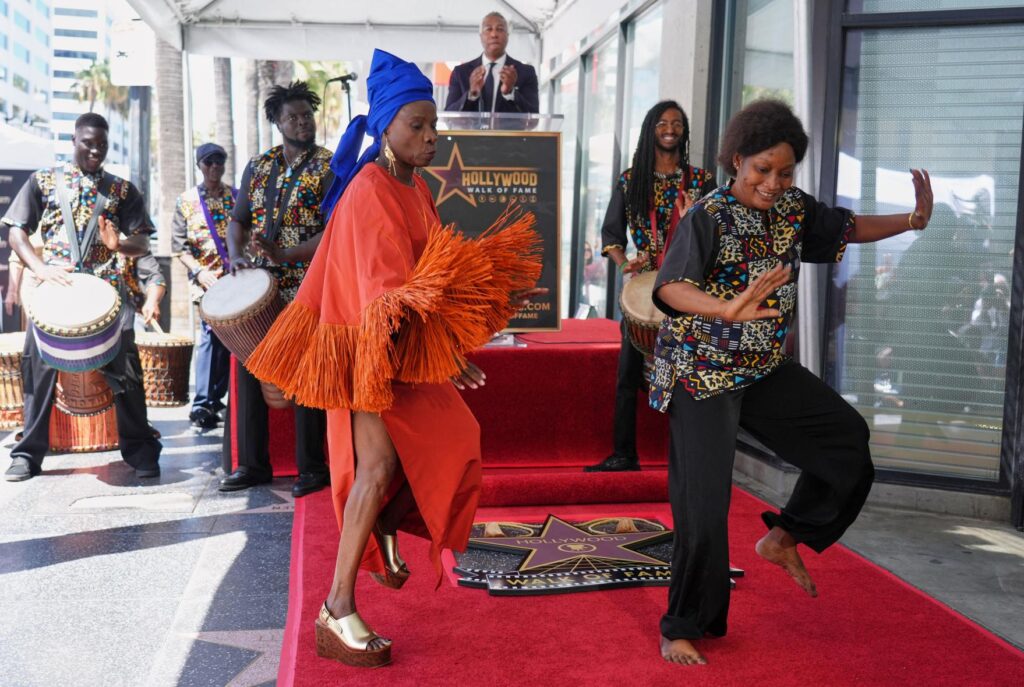
Then she broke into song and danced on her own star. Ron Frierson, president and CEO of the Hollywood Chamber of Commerce, had just proclaimed August 18 Angélique Kidjo Day.
She had already told the AFP, when the honor was announced in the summer of 2025, that she may be the first African woman with a star on the Walk of Fame, but she is certain she will not be the last.
“When you know where you come from, you can go anywhere.” — Angélique Kidjo, La Libre, August 16, 2026