

A Franco-Congolese actress trained in Paris, directed by France’s leading stage and screen names, has worked for a Central African production exactly once — on a self-financed film whose technical shortcomings its own director attributes to the absence of funding.
The numbers. Two of eleven Central African states operate a film support fund. Regional seed capital in 2025: €115,000 across seven projects. One French feature carrying a Congolese-origin actress in a supporting role: €42 million.
The institutional question. The support architecture that does exist is built around ECCAS. CEMAC — six states, one currency, one development bank, one integrated financial market — has no identified instrument for the cultural and creative industries.
Read a performer’s CV as a capital flow
There is a way of reading an artist’s résumé that interests neither critics nor audiences, but ought to interest an economist: as a flow.
Gaëlle Voukissa’s is unambiguous. Training in France — Cours Florent in 2006, the school’s selective Classe Libre in 2009. Employment in France: seventeen years on Paris stages, from the Théâtre Nanterre-Amandiers to the Studio Marigny, by way of the Cartoucherie de Vincennes and the Théâtre du Palais-Royal. Film in France: a role in Cédric Jimenez’s Chien 51, released in October 2025 on a budget of roughly €42 million — the largest French production of the year after Luc Besson’s Dracula. Television in France: a six-part TF1 series shot in the Cantal in 2025, currently in post-production.
Lari — a language of southern Congo-Brazzaville — appears among the languages she lists as fluent on her agency file. That is, in this entire dossier, very nearly the only economic trace of Central Africa.
With one exception. In 2022 she appears in Mayouya, a Congolese feature directed by Claudia Yoka. And that exception is a textbook case.
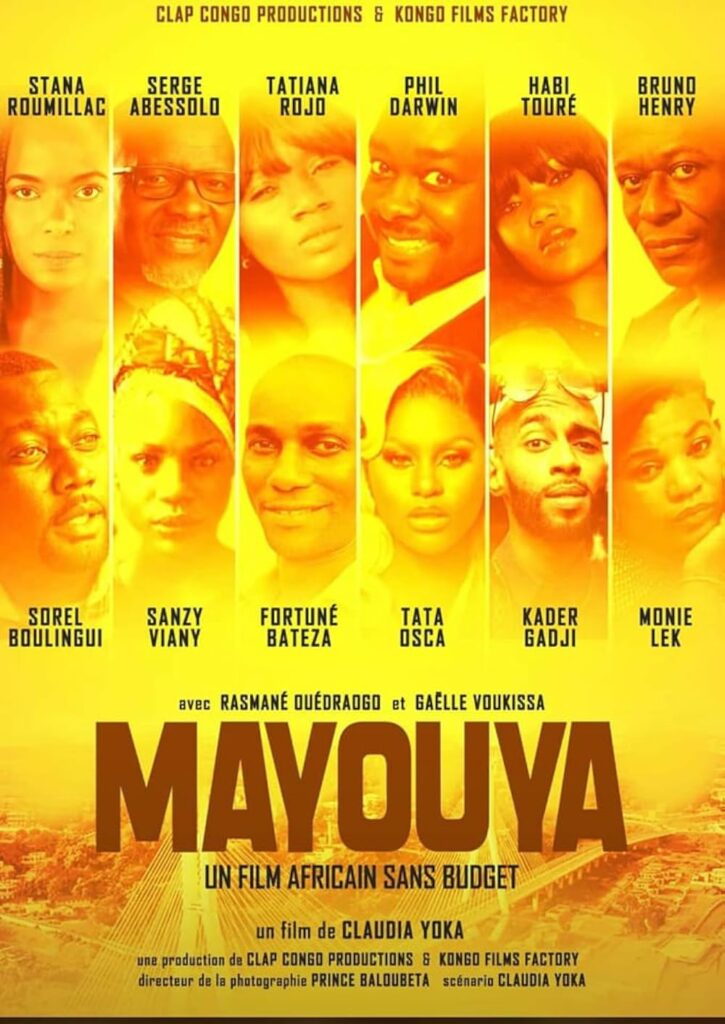
Mayouya: a film about the funding gap, crippled by the funding gap
The premise is an irony no screenwriter would dare invent. A Congolese director cannot finance a film about female genital mutilation. Her loan application is refused. The bank manager offers to become her lover instead of her creditor. She retaliates by organising a virtual heist of the institution, with help from a friend who robs banks and a brother familiar with police stations.
Claudia Yoka, who founded the Clap Congo association in 2002, has never disguised the documentary weight of the plot. Speaking in Cannes in 2022, she explained that she used comedy because the direct register finds no audience. In an interview with the Congolese press she had put the underlying problem plainly: elsewhere artists receive public support, but in Congo filmmakers fund their own projects — which, she said, does not allow them to make quality films.
The film then proved her point. At its Canadian premiere at Montreal’s Vues d’Afrique festival in April 2023, a reviewer praised the subject and the ambition while identifying one central flaw: the sound recording. Unusually, the director replied publicly to accept the criticism, citing severe difficulties with sound and the unseriousness of would-be financiers.
In sector terms: a strong subject, a pan-African cast drawn from Senegal, Côte d’Ivoire, Gabon, Burkina Faso and Congo, an international festival run — and a finished product whose technical quality is capped by the absence of pre-financing. This is not a talent problem. It is a capital structure problem.
The Dakhla award, or what a jury rewards when there is no industry
Mayouya was recognised at the Dakhla International Film Festival in Morocco in 2023 with the prize for best female performance.
An essential clarification, because the fact circulates in distorted form: according to Africiné, the reference database for African cinema, the award went collectively to all of the film’s actresses, not to any individual performer. Claudia Yoka has herself confirmed that the jury was honouring the subject and the ensemble’s playing.
That distinction is not cosmetic. A jury that rewards a collective rather than a performance is, implicitly, rewarding the production effort itself in a constrained environment. It is a festival honour, not a tradable asset. It opens no residual rights, no access to a funding window, no co-production premium. It does not move the profit and loss account.
The structural number: two funds, eleven countries
The figure that frames everything comes from the Organisation internationale de la Francophonie and the Filmer en Afrique centrale association (Filmac), published around the 2025 Filmac Prizes: across a region of eleven countries and more than 200 million people, only two states operate a film support fund.
The regional contrast has been documented since 2022. West Africa, led by Burkina Faso, Côte d’Ivoire and Senegal, already had six active funds. Central Africa had none. Cameroon had in fact created a film industry development fund, FODIC, as early as 1973 — it ran dry in the early 1990s. Yaoundé has since rebuilt a mechanism, financed by tax receipts from the audiovisual sector and by budget appropriations.
The professional diagnosis has been consistent: Central African producers face structurally greater difficulty financing projects than their North and West African counterparts, who are better trained and better funded locally.
A substitute mechanism does exist, and it is external. The Filmac initiative, launched at a Yaoundé seminar in 2022 under ECCAS patronage with support from the ACP-EU Culture programme, created seed prizes in 2023. Stated cumulative result: close to €600,000 committed over three years to 21 projects — short and feature fiction, documentary and series. The 2025 edition distributed more than €115,000 across seven projects from five countries, including Equatorial Guinea and Burundi for the first time, with the OIF, French embassies, Canal+ and two technical laboratories in Casablanca and Dakar among the contributors.
For scale: €115,000 distributed in a year across all of Central Africa, against €42 million for a single French feature carrying an actress of Congolese heritage. A ratio of roughly one to 365.
That comparison is rhetorical rather than analytical — a regional seed facility is not a feature budget. It is offered as an order of magnitude, and it is the order of magnitude that matters.
The institutional blind spot: CEMAC is not in the architecture
One point deserves this publication’s readers’ attention, because it concerns the sub-region’s institutional design.
The perimeter set by the Filmac Prize regulations for the 2025-2026 session is that of ECCAS — eleven member states, from Angola to Chad. The 2022 founding seminar was likewise held under ECCAS patronage, and the resulting roadmap was presented to the ECCAS culture ministers’ meeting in Kinshasa in October 2022.
CEMAC — six states, a common currency, a regional development bank, an integrated financial market — does not appear as the sponsor of any dedicated instrument for the cultural and creative industries.
This is not a matter of nomenclature. Creative industries present precisely the risk profile that regional guarantee and pre-financing mechanisms exist to address: intangible assets, long production cycles, deferred and uncertain revenues, no conventional collateral. That is exactly why commercial bank credit turns them away — which Mayouya dramatises, literally, in its plot.
The question put to the institutions of the Central African franc zone is therefore simple and open: does a regional guarantee or seed mechanism, funded by an earmarked levy on audiovisual receipts along Cameroonian lines, fall within their mandate? As of today, no such instrument has been identified at CEMAC level.

The real cost: human capital that is never captured
Under-funding in a cultural sector is normally measured by what it fails to produce. It is rarely measured by what it fails to retain.
The Voukissa case puts a value on that second quantity. Here is a professional capable of carrying Racine on the stage of a national drama centre, Shakespeare on tour, Rostand across three seasons in a ten-strong ensemble, a contemporary thriller played two hundred times to more than 100,000 spectators, and a role in a €42 million science-fiction production. That competence was trained, employed and paid for entirely outside the sub-region.
Central Africa drew on it once, in 2022, on a self-financed film.
This is no criticism of the performer. Nobody can be expected to work in an industry that lacks the means to employ them. It is a description of an attractiveness deficit. Until a financeable volume of regional production exists, talent formed by or drawn from the diaspora will return only as an occasional, unpaid act of commitment. Industries are not built on acts of commitment.
The human capital exists. The financial capital does not. What is missing between them is an instrument — and an instrument is, by definition, what an economic and monetary community is supposed to know how to build.
Key figures
| Indicator | Value | Source |
|---|---|---|
| Central African states (ECCAS perimeter) with a film support fund | 2 of 11 | OIF / Filmac, 2025 |
| Active funds in West Africa (2022 assessment) | 6 | Filmac seminar, Yaoundé |
| Filmac Prizes, cumulative three-year commitment | ≈ €600,000 across 21 projects | OIF / Filmac |
| Filmac Prizes 2025 | > €115,000 across 7 projects, 5 countries | OIF / Filmac |
| Budget of Chien 51 (France, 2025) | ≈ €42m | French trade press |
| FODIC, Cameroon: creation to exhaustion | 1973 – early 1990s | Jimbere / Filmac |
| Mayouya at Dakhla 2023 | Best female performance, awarded collectively | Africiné |