


From financing subsistence to investing in transformation, the continent alters its economic calculus. An appraisal of a pivotal moment that may alter everything — or nothing whatsoever.
Addis Ababa, February 2026 — One had ceased to believe it possible. Then, quite without warning, something shifted. Not a dramatic rupture, certainly not a revolution. Merely a subtle semantic displacement, almost imperceptible, yet potentially momentous. At the 2026 Forum, finance ministers no longer spoke of “deficits” requiring remedy. They invoked “productive capacities” awaiting construction. Traditional donors no longer mentioned “technical assistance” but rather “industrial partnership”. Africa, long confined to the role of economic supplicant, awakens as architect of its own destiny.
The End of the Plaster Era
For fifteen years, the ritual remained immutable. African summits opened with identical diagnoses: unsustainable debt, imbalanced budgets, appeals for international relief. Structural adjustment programmes followed one another with wearying predictability. The continent pursued macroeconomic stability as others pursue time itself — perpetually elusive, forever receding. COVID-19, the energy shock, galloping inflation: each crisis reinforced the same infernal circuit — borrowing to survive, surviving to repay.
The 2026 Forum fractures this mechanism. The rupture lies not in the figures. It resides in the intention. “A financed deficit stabilises,” observed a Senegalese economist in the conference corridors. “Productive investment transforms.” The distinction? Subtle upon the page. Monumental in execution. The passage from managing scarcity to creating abundance. From supportive therapy to the surgery of development.
The Factory Versus the Budget
Words possess consequences. When delegations now evoke “factories”, “logistical infrastructure”, “industrial ecosystems”, they do not describe pious hopes. They sketch a map. That of an Africa no longer content to export what it extracts from the soil, but transforming what it produces. Cocoa becoming chocolate, ore becoming electronic components, cotton becoming finished textiles.
Côte d’Ivoire, present in force at Addis Ababa, embodies this metamorphosis. The country no longer merely sells beans. It constructs chocolate manufactories. Morocco does not rest content with phosphates. It assembles motor cars. Ethiopia no longer counts its agricultural labourers. It trains industrial park operatives. Political choices. Risky wagers. Horizons of ten, fifteen, twenty years — an eternity for governments habitually pressed by the short term.
The Impatient Capital Departs, the Patient Capital Returns
The difficulty? Informed money fled such projects. Too lengthy. Too uncertain. Too African, one heard murmured in the antechambers. Institutional investors preferred sovereign bonds — profitable, liquid, rapid — to processing plants: illiquid, complex, distant. Elevated interest rates on the continent aggravated the misunderstanding. Why assume industrial risks when sovereign debt yielded eight, ten, twelve per cent?
The 2026 Forum proposes a response: de-risking. Not the elimination of risk — impossible — but its mutualisation. Multilateral guarantees, investment insurance mechanisms, standardised public-private partnerships. The notion? To render African industry bankable. Not through charity. Through financial engineering. Rome commits itself. Italy, through enhanced cooperation, wagers upon agricultural and energy value chains. Berlin follows, seeking to secure its supply lines. New Delhi, surprise guest at the forthcoming France-Africa Summit, perceives in the continent a manufacturing workshop for its own expansion.
The Market That Was Missing
All this ambition hitherto confronted a simple obstacle: scale. Who invests in a factory when the national market numbers fifteen million consumers, dispersed, poorly connected, sometimes bordering yet separated by customs barriers? The African Continental Free Trade Agreement (AfCFTA) attempts a response. One and a half billion persons. A harmonised economic space — in theory. Economies of scale finally possible — in practice, perhaps.
Scepticism remains warranted. Logistical corridors struggle to emerge from the earth. Special economic zones operate sluggishly. National bureaucracies resist integration. Yet the signals alter. Chinese enterprises, already present upon construction sites, now interest themselves in consumers. European firms, historically concentrated upon extraction, explore transformation. African capital itself — diaspora, sovereign funds, substantial private fortunes — begins its homeward journey.
The Crucible
The essential remains. However inspiring the discourse, it does not construct factories. Investment announcements do not guarantee employment. Africa remains a continent of paradoxes: rich in resources, poor in infrastructure; youthful in population, ageing in its institutions; ambitious in projects, dependent in finance.
Public debt, despite restructurings, weighs heavily. Security instability, from the Sahel to the Horn, alarms. Asian, Indian, Turkish competition rages fierce. American and European protectionism, far from disappearing, metamorphoses into technical and environmental barriers.
Yet the debate has altered its character. Africa no longer presents itself as a problem requiring finance. It proposes itself as an opportunity to seize. The 2026 Forum, in a decade, shall perhaps be forgotten. Or cited as the moment when the continent ceased begging alms to dare industry. The stakes, hereafter, lie upon the assembly lines. Not in the speeches.
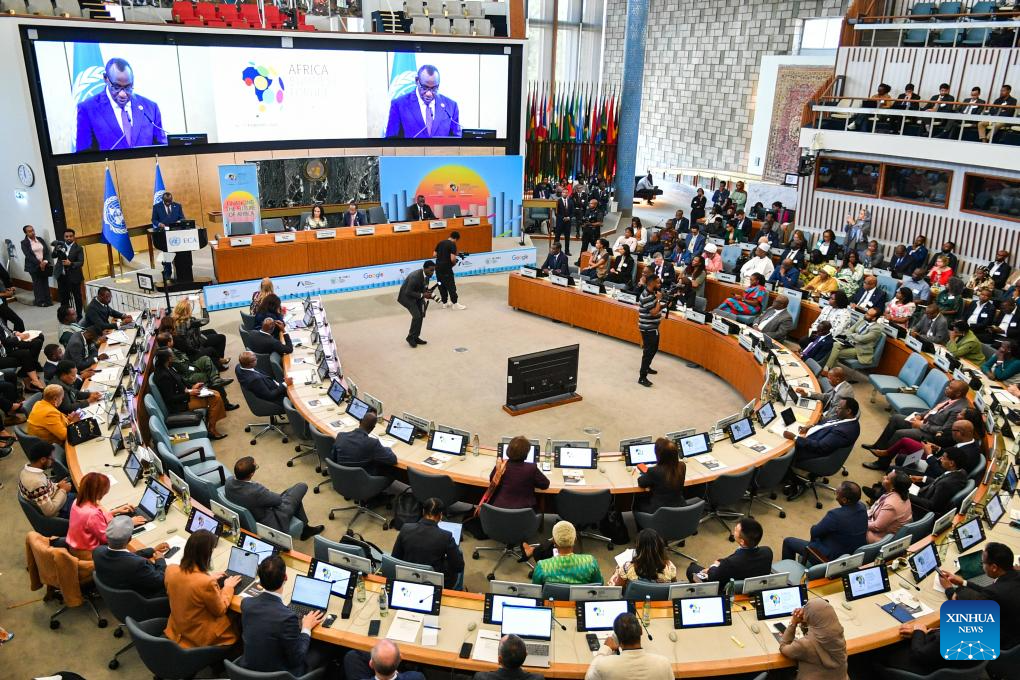
Addis Ababa, session’s end — The delegations depart with portfolios beneath their arms. Memoranda of understanding. Promises. The true labour commences on the morrow. As ever it has.