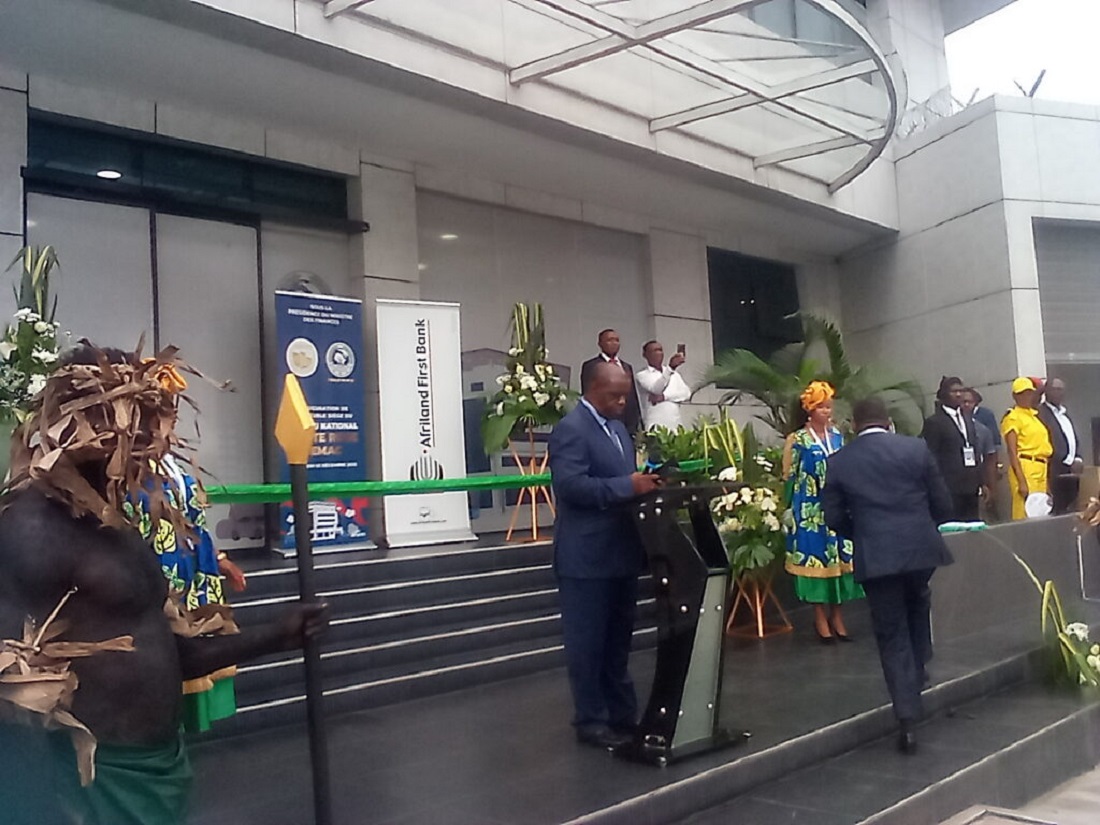
The inauguration in Douala of the new headquarters of the CEMAC National Pink Card Office, financed at a cost of 2.7 billion CFA francs, signals a strengthening of integration in Central Africa. The building structures cross-border clearing mechanisms and reinforces the tools of sovereignty and financial stability within the Central African Economic and Monetary Community (CEMAC).
The official opening of the CEMAC National Pink Card Office headquarters in Douala, presided over on December 3, 2025, by the Minister of Finance, Louis Paul Motaze, is part of a broader process of institutional structuring in Central Africa. The building, costing 2.7 billion CFA francs, constitutes an operational link in the regional ecosystem dedicated to the free movement and financial management of cross-border road risks.

In inaugurating this infrastructure, the Minister of Finance reiterated that Cameroon is thus fulfilling the commitments made by the Heads of State of the sub-region for more integrated cooperation. The Pink Card, established on July 1, 1996, is a legal mechanism allowing insured motorists to drive in the six member countries without purchasing additional insurance. This tool plays a role in regulatory harmonization and financial interoperability between national systems.
The Cameroonian National Bureau, established by ministerial decree on May 3, 1999, received a public guarantee of 20 million FCFA at its launch, intended to secure the mechanism. This guarantee constitutes a signal of state support for the management of cross-border road risks and the protection of road users. The minister emphasized that this institutional framework serves to stabilize transactions between insurers while ensuring continuity of service within the country.
Richard Lowé, founder of Activa, reiterated that the Pink Card is not an insurance company, but a financial integration system applicable across several regions of the continent. Each region has its own version: the Brown Card in West Africa, the Green Card in North Africa, and the Yellow Card in Southern Africa. The continental objective is to ensure consistent management of interstate travel risks through a set of common rules and a centralized claims settlement system.
“In the distressing situations faced by victims of accidents involving foreign drivers, this place must be the first point of contact, the place where the State is present, where administrative justice takes shape, where community solidarity is realized,” declared Louis Paul Motaze in his address. He continued: “The national bureau is not the insurer of the liable party. It cannot be subject to joint seizures simply by analogy, because the Republic never confuses system guarantees with contractual liability.”
The building inaugurated in Douala strengthens this regional infrastructure. According to Richard Lowé, it symbolizes Cameroon’s capacity to support the CEMAC financial mechanisms and consolidate its position within integration systems. Its commissioning improves the operational conditions of the system, particularly in terms of file processing, inter-office coordination, and administrative governance.
The infrastructure is part of the CEMAC’s financial regulation and trade stabilization instruments, in a context where the free movement of people and goods remains a key objective for the sub-region. The Douala headquarters now constitutes a physical element strengthening the institutional and operational interconnection necessary for a more integrated Central Africa.