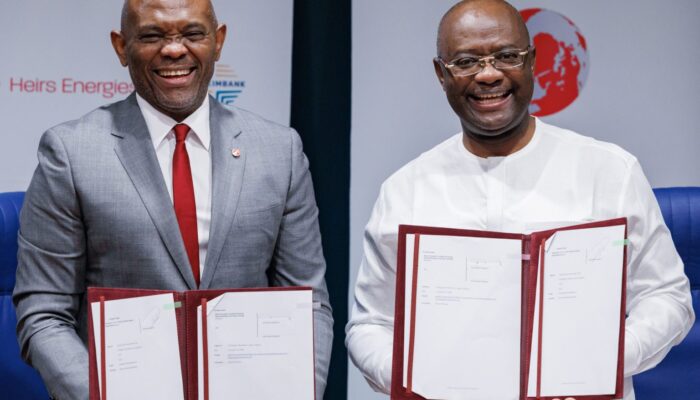
Six weeks after Fitch downgraded it to sub-investment grade and walked away, Afreximbank closed its largest-ever syndicated loan — $2 billion from 31 lenders across four continents. Markets said yes where rating agencies said wait. The story behind a defiant transaction.
KEY FIGURES
| $2B FINAL FACILITY SIZE Largest syndication in Afreximbank history | 31 PARTICIPATING LENDERS Europe, Middle East, Asia & Africa | 157% OVERSUBSCRIPTION RATE $2.36B committed vs $1.5B target | Baa2 SOLE WESTERN INV. GRADE Moody’s (stable) — Fitch withdrawn |
A Record That Defies the Narrative
TRANSACTION AT A GLANCE
| Concluded | 9 March 2026 |
| Announced | 30 March 2026 |
| Structure | Dual tranche, 3-year syndicated term loan |
| Tranche A (USD) | $1.73 billion |
| Tranche B (EUR) | €228 million |
| Launch size | $1.5 billion equivalent |
| Total commitments | $2.36 billion (oversubscribed) |
| Final size | $2 billion equivalent |
| Lenders | 31 — Europe, Middle East, Asia & Africa |
| Global coordinators | Mashreqbank PSC · MUFG Bank · Standard Chartered Bank |
| Use of proceeds | Refinancing of existing facilities + general corporate purposes |
On 30 March 2026, the African Export-Import Bank (Afreximbank) announced the successful conclusion of a $2 billion equivalent three-year dual-tranche syndicated term loan — its largest ever. The facility had been launched on 9 March at a target of $1.5 billion. It closed with $2.36 billion in commitments, reflecting a significant oversubscription before being scaled back to the final $2 billion size. Thirty-one lenders from across Europe, the Middle East, Asia and Africa participated.
The timing is what makes this transaction remarkable. It closed just weeks after a bruising public confrontation with Fitch Ratings, which had downgraded Afreximbank to sub-investment grade and subsequently withdrawn its coverage entirely. In any other context, raising capital at record volume so shortly after such a rating action would be considered improbable. Yet the market’s response was unambiguous: the oversubscription ratio tells a story that the rating agencies’ models, apparently, do not.
“This transaction is the largest ever syndicated facility borrowing by Afreximbank. It is a clear demonstration of global investors’ confidence in the bank’s credit story, and affirms our strong access to international markets.”
— Chandi Mwenebungu — MD, Treasury & Markets and Group Treasurer, Afreximbank

The Fitch Rupture — A Break Months in the Making
To understand the significance of the March 2026 raise, one must trace the deterioration of Afreximbank’s relationship with Western rating agencies over the preceding year — a process that accelerated sharply in the second half of 2025.
JUNE 2025
Fitch downgraded Afreximbank to BBB– / Negative outlook, citing concerns over funding source diversification and concentration of the loan book in financially stressed sovereign borrowers.
JULY 2025
Moody’s followed with a downgrade to Baa2 / Stable, noting reduced diversification of funding sources and the scale of exposure to fragile states. The bank retained investment-grade status with the American agency.
DECEMBER 2025
The Ghana debt restructuring reached an agreement with Paris Club support, covering $13 billion in sovereign obligations. Afreximbank, which had resisted creditor haircuts on its $750 million loan citing preferred creditor status, was ultimately drawn into the settlement — a precedent with lasting implications for multilateral finance.
23 JANUARY 2026
Afreximbank formally terminated its relationship with Fitch, declaring that the rating process no longer reflected an adequate understanding of the bank’s constitutive agreement, mission and mandate.
28 JANUARY 2026
Fitch responded five days later, downgrading Afreximbank from BBB– to BB+ (sub-investment grade) with a stable outlook, then withdrew all future ratings. The bank’s 3.798% 2031 bonds fell immediately, with their yield spiking to 6.3%.
9 MARCH 2026
Despite this turbulence, the $2 billion syndicated facility closes — oversubscribed by 57% — with 31 lenders from four continents. A record, in every sense.
A Fragmented Ratings Landscape
The Fitch break has left Afreximbank in an unusual position: rated investment grade by only one of the three major Western agencies, yet assigned top-tier ratings by a constellation of Asian and African rating bodies. This divergence reflects fundamentally different analytical frameworks for assessing multilateral development banks operating in emerging markets.
AFREXIMBANK · CURRENT RATINGS BY AGENCY
| AGENCY | RATING | GRADE | OUTLOOK | NOTE |
| Moody’s | Baa2 | Investment Grade | Stable | Assigned July 2025 |
| Fitch | BB+ | Sub-Investment | Stable | Withdrawn Jan 2026 |
| GCR | A | Investment Grade | International | Affirmed March 2026 |
| CCXI (CN) | AAA | Highest Grade | Chinese scale | |
| JCR (JP) | A– | Investment Grade | Japan scale |
The ratings map above encapsulates a structural tension in the global financial architecture. Western agencies — shaped by frameworks built for commercial lenders — tend to apply standard metrics around portfolio concentration, sovereign exposure and equity leverage. These metrics, when applied to a development bank with an explicitly developmental mandate, can produce assessments that diverge from actual credit behaviour. Afreximbank has not recorded a single annual loss since its founding in 1993. Its $6.5 billion capital increase is approved and underway. Its balance sheet stands at over $40 billion in total assets. Yet by Fitch’s models, it no longer merits investment grade.

Asian and African agencies, by contrast, appear to weight the developmental mandate and track record of capital preservation more heavily. The divergence is not new — it echoes broader debates about the fitness of Western credit methodologies for institutions operating at the intersection of finance and sovereign development policy.
Real Risks, Real Tensions
Intellectual honesty demands acknowledging what the oversubscription does not resolve. The concerns raised by rating agencies point to genuine structural vulnerabilities that Afreximbank will need to address with clarity and transparency over the coming years.
Concentration risk
According to Japan Credit Rating Agency, more than 70% of Afreximbank’s portfolio is concentrated in five countries — Nigeria, Egypt, Zimbabwe, Tunisia and Angola. This level of geographic concentration creates correlated exposure to idiosyncratic sovereign shocks that may not be immediately visible in aggregate performance figures.
Leverage
The bank’s loan exposure represents more than 430% of its equity base — rising to approximately 600% when guarantees and undisbursed commitments are included. For a commercial bank, this would be cause for alarm. For a development institution with preferred creditor status and implicit sovereign backing, the calculus is different — but the headline figures remain significant.
The preferred creditor status question
The Ghana episode introduced a precedent that the financial community will not quickly forget. When Accra restructured $13 billion in external obligations, it initially argued that Afreximbank should absorb losses alongside commercial creditors — a direct challenge to the bank’s constitutive preferred creditor status. The final Paris Club-supported settlement appeared to resolve the standoff in Afreximbank’s favour, but sources close to official creditors suggest the bank may have accepted concessions to secure Paris Club endorsement. If confirmed, this would mark the first formal erosion of a legal protection that underpins Afreximbank’s entire risk model.
The oversubscription of the March 2026 facility answers one question convincingly — Afreximbank retains access to international capital markets. It does not answer the deeper question of what preferred creditor status means in practice when African sovereigns restructure.
The Geopolitics of Capital
The composition of the syndicate — lenders from Europe, the Middle East, Asia and Africa — is itself a geopolitical statement. The participation of Middle Eastern institutions such as Mashreqbank PSC, alongside Japanese banks like MUFG and Asian lenders, signals that the gravitational centre of capital flows to Africa is shifting. A separate $500 million facility syndicated exclusively to Asian lenders in June 2024, combined with Afreximbank’s second Samurai bond — JPY 81.8 billion (~$527 million) in November 2025 attracting more than 100 Japanese institutional and retail investors — illustrates a deliberate strategy to build deep relationships with non-Western capital pools.
This strategy carries both opportunity and risk. The diversification away from Western funding reduces Afreximbank’s vulnerability to Western ratings-agency pressure — as the March 2026 raise demonstrates. But it also repositions the bank within broader geopolitical alignments at a moment of heightened competition between Western and Eastern financing frameworks for African infrastructure and trade.
Afreximbank’s standing in the 2025 Bloomberg Africa Borrower Loans League Tables — where it ranked first as both Mandated Lead Arranger and Bookrunner — underscores its dominance of the African syndicated lending market. That dominance now rests on a capital base that is structurally more Asian and Middle Eastern than it was five years ago.
EDITORIAL PERSPECTIVE
Afreximbank’s $2 billion raise is, first and foremost, a market vote of confidence. Thirty-one lenders, given full visibility of the Fitch rupture, the Ghana precedent and the concentration metrics, chose to commit capital at record levels. That is not naivety — it is a deliberate assessment of risk by sophisticated institutions with their own credit analysts.
The deeper story is one of institutional architecture under stress. Whether Afreximbank’s South-South capital pivot is a durable strategy will depend, in large part, on how the preferred creditor status question is resolved across future sovereign debt restructurings. That question has no clean answer yet. The $2 billion says markets are willing to wait for one.
Afreximbank’s record $2 billion syndicated facility, concluded in the shadow of a historic ratings rupture, is one of the most instructive transactions in African institutional finance in years. It confirms that the bank retains deep and genuine access to global capital markets. It also surfaces, with unusual clarity, the fault lines between Western credit frameworks and the realities of multilateral development banking in Africa. The institution’s fundamentals — three decades without a loss, a $40 billion balance sheet, a $6.5 billion capital raise in progress — provide a credible foundation. The path forward demands both the transparency to address structural vulnerabilities head-on, and the strategic clarity to shape, rather than simply react to, the global debate over preferred creditor status. The market has bought time. How Afreximbank uses it will define its decade.
Keywords: Afreximbank • African Finance • Syndicated Loans • Fitch • Credit Ratings • Capital Markets • AfCFTA • Development Finance • Preferred Creditor Status