

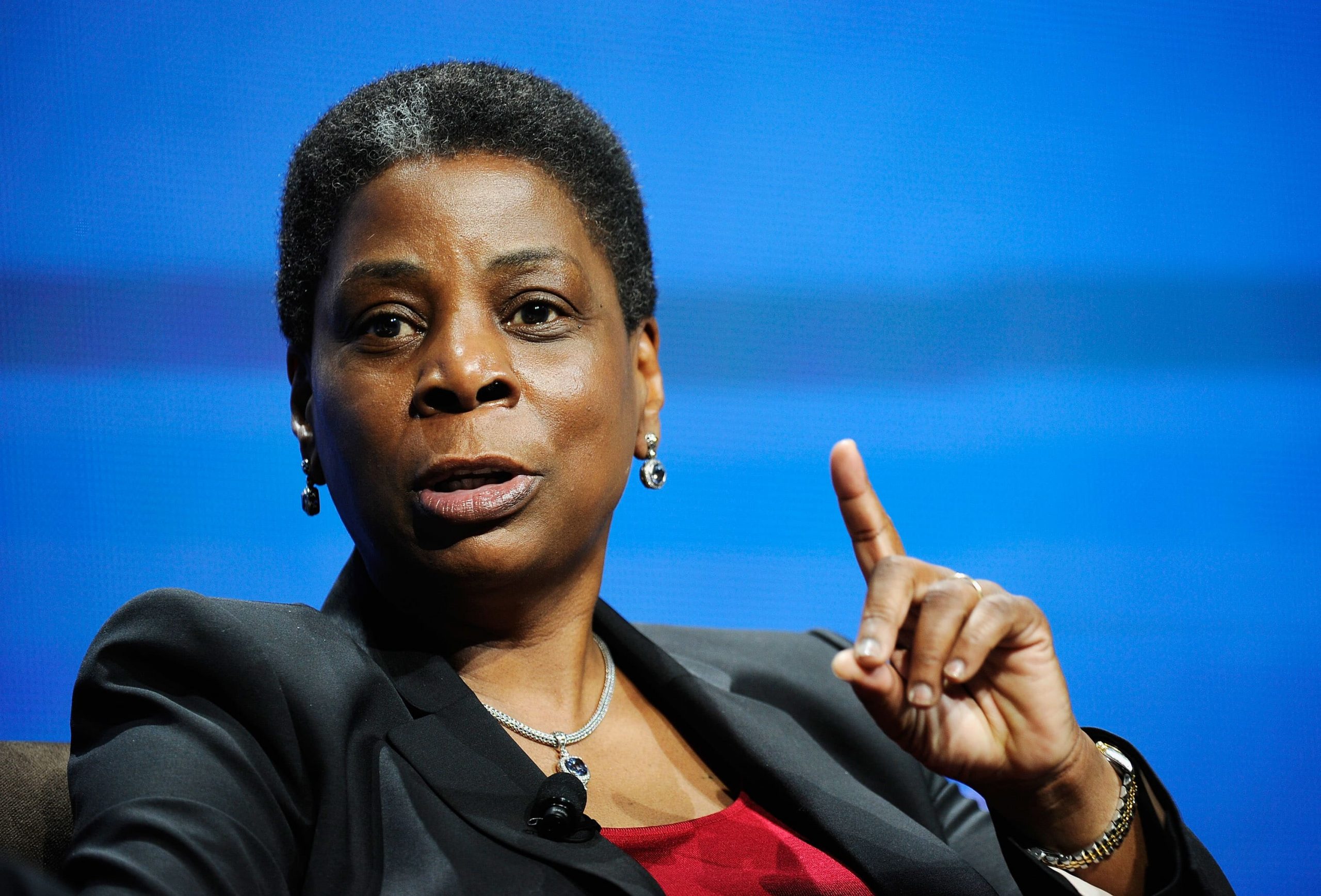
Trajectories — Portrait No. 2
Ursula Burns took over a company whose product was being erased by the internet, and spent $6.4bn — the largest acquisition in Xerox’s history — buying a different business to become. Six years later the group was split back in two under pressure from an activist holding roughly 15% of the stock. The rise from a Lower East Side housing project to the top of the Fortune 500 is the famous part. The harder question is what a chief executive can actually do about structural obsolescence.
| Joined Xerox | 1980, as a summer intern |
| Became CEO | 1 July 2009 |
| ACS acquisition | $6.4bn — largest in company history |
| Shareholder approval | 96% (Xerox) / 86% (ACS) |
| Headcount after the deal | 130,000+ |
| Xerox share of the print market, c. 2016 | ~11% |
| Split into Xerox and Conduent | 2016 |
| Icahn + Deason combined stake, 2018 | ~15% |
| Memoir published | June 2021 |
Olga Burns ran a daycare out of her apartment in a Lower East Side housing project and took in ironing to pay for Catholic school. She raised three children largely alone. Her daughter Ursula studied mechanical engineering at Polytechnic Institute of New York, took a master’s at Columbia in 1981, and by then had already spent a summer interning at Xerox.
The engineering matters more than it looks. Burns did not enter corporate America through finance, consulting or business school — the standard routes for her generation of American executives. She entered through a discipline that produces verifiable results. For a young Black woman presumed incompetent by default, that was not a preference. It was the only currency that didn’t require anyone’s permission.
The internship became a job, the job became thirty-five years, and somewhere in the middle came the moment the story turns on: Burns publicly contradicted a senior executive in a meeting. He did not discipline her. He hired her as his executive assistant.
The usual reading is a lesson in courage. The colder reading is more useful. What changed was not her competence but her visibility — the move from technical execution, where you are judged on output, to the top floor, where you are judged on judgement. No amount of engineering ability produces that jump on its own. It requires access, and access is given.
She became president in 2007, then chief executive on 1 July 2009, chosen by Anne Mulcahy — the first time one woman had handed a Fortune 500 company to another.
The inheritance
Xerox invented photocopying and gave English a verb. It also housed, at Palo Alto Research Center, a good share of the inventions underpinning personal computing, and monetised almost none of them. By the time Burns took over, its share of the print and copy market it had created was down around 11%. Revenue was falling.
The threat was not a competitor. It was that the world had started printing less.
Business schools call this structural obsolescence, and the important thing about it is that operational excellence does not fix it. No margin improvement saves a business that is disappearing.
The bet
Two months into the job, in September 2009, Burns announced the purchase of Affiliated Computer Services for $6.4bn — a business process outsourcing firm handling data and administrative services for companies and governments. It was the largest deal Xerox had ever done.
The reasoning was explicit: Xerox could not grow in print, so it would become a services company. Shareholders agreed overwhelmingly — 96% on the Xerox side, 86% at ACS — despite concerns about the debt. Headcount passed 130,000.
The negotiation itself is the more instructive part. By Burns’s own account, the sticking points were not valuation but the super-voting preferred stock held by ACS founder Darwin Deason, who owned a quarter of the company, and the personal arrangements attached to his position. Transformative deals rarely stall on strategy.
Remember the name. Deason returns eight years later, as a plaintiff.
What the profiles leave out
In January 2016, Xerox announced it would split into two listed companies: Xerox for print, Conduent for the services acquired with ACS.
The official biographies describe a successful separation led by Burns. The financial press at the time described something else: an unwinding of the 2010 bet, under pressure from activist investor Carl Icahn, then the second-largest shareholder, who secured the right to appoint three directors to the services company’s board. Whoever took over Xerox was left facing the original problem, still dependent on print, with no obvious answer.
Both readings hold. A $6.4bn acquisition dismantled six years later under shareholder pressure is not, structurally, a vindication. Doing nothing and letting the decline run its course was not an alternative either.
Burns left the chief executive role at the end of 2016 and the chairmanship in 2017, having said the board’s job was to work out the best path for the company rather than the best role for her.
The coda is harsher. In 2018 Xerox agreed to a takeover by Fujifilm. Icahn and Deason, holding roughly 15% between them, called the company undervalued and sued — a complaint naming the former leadership, Burns included, over a provision they alleged had been withheld from shareholders for years. Xerox’s board publicly rejected the claims. The deal collapsed in May. Allegations by litigating shareholders are not findings, but they are part of the record.
The second career
What followed is instructive for a different reason. Burns did not retire. She changed her position in the system.
Chair of telecoms group VEON from 2017, briefly its chief executive between 2019 and 2020. Director at Uber, ExxonMobil, American Express, Endeavor, IHS Holdings. Non-executive chair of Teneo, co-founder of the private equity firm Integrum, executive chair of a listed acquisition vehicle. Earlier, head of the White House STEM programme under Obama and chair of the President’s Export Council.
That is not an honorific retirement. It is the move from operating power — running a company — to allocative power: deciding where capital goes and who runs it. In mature economies that second tier is where most of the outcome is determined, and it is nearly invisible from outside.
Her 2021 memoir carries the argument in its title: Where You Are Is Not Who You Are.
Read from Douala or Libreville
Technical competence travels through hostile rooms. Burns rose by being verifiable, not by being liked — the least permission-dependent asset available in any market where careers turn on family, regional or political networks.
Judge a chief executive on the inherited problem, not the share price. The useful question about Burns is not whether she created value but whether anyone else would have done better with the same asset. That distinction is worth importing wholesale into how the region assesses the managers of its state-owned enterprises, many of whom take over businesses whose model died before they arrived.
A transformative acquisition is not a strategy. It is a dated bet, and it requires winning three fights at once — integration, debt, and the shareholders’ clock. Xerox won the first, survived the second, and lost the third.
And capital eventually speaks. An activist with 15% shaped the company’s direction more decisively than seven years in the chief executive’s chair.
Tomorrow: Célestin Tawamba, the Cameroonian industrialist who chose to manufacture in an economy that rewards importing.